When Two Tarot Readings Seem to Disagree
When two tarot readings seem to disagree, compare the question, context, spread roles, cards, and your notes before deciding one was wrong.
Aurora @ Liminal Tarot
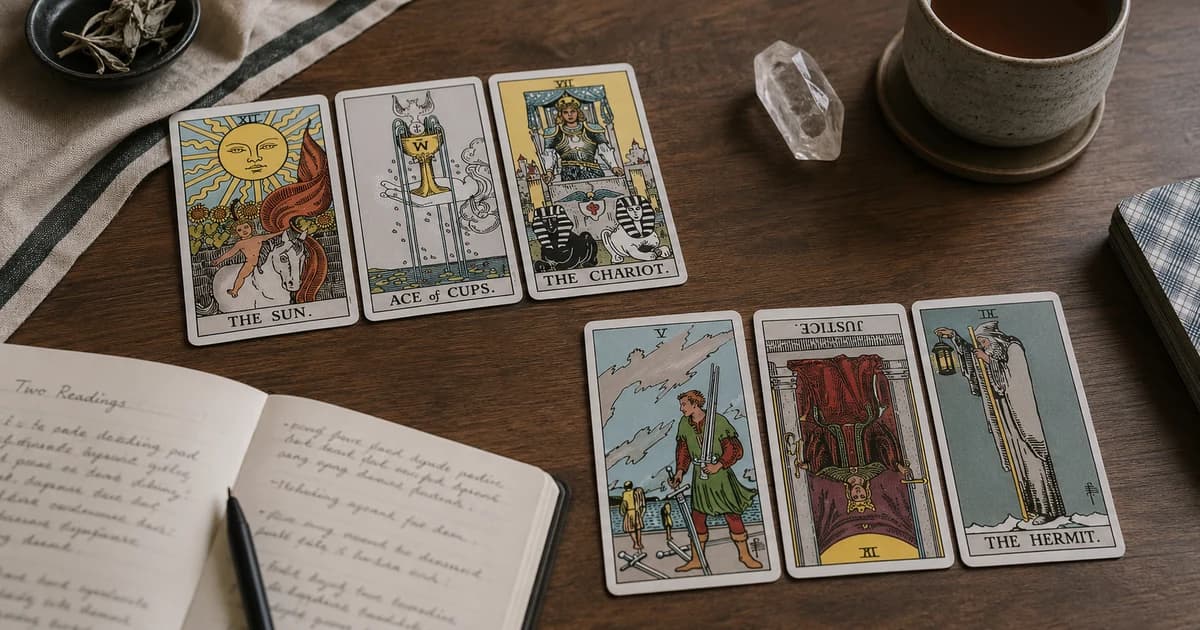
Two tarot readings can look contradictory before you have checked whether they were actually doing the same job.
Last week's reading seemed to lean toward movement. Today's seems cautious. One spread felt open; the other feels constrained. It is tempting to decide that one of them was wrong, or to keep interpreting until both can be folded into one neat message. Neither move is necessary.
Before comparing the conclusions, compare the conditions of the readings: the exact question, what was happening around it, the jobs performed by the spread positions, what repeated or changed in the cards, and what you noticed at the time. Sometimes the contradiction becomes smaller once those differences are visible. Sometimes it remains. A useful comparison has room for both outcomes.
A more useful question is What changed, what stayed stable, and what is still unresolved?
Start with the question and the situation around it
Small wording changes can move a reading into a different frame. “Should I leave this job?” and “What should I pay attention to if I stay for six more months?” are both about the same job, but they are asking for different kinds of reflection.
The first is framed around an immediate decision. The second assumes a period of staying and asks what matters inside it. Subject, time horizon, point of view, specificity, and the assumptions built into the wording all affect what the reading is being asked to examine. If those differ materially, the readings are not two votes on an identical problem.
The surrounding situation matters just as much. A conversation happens. An offer arrives. A deadline moves. An option disappears. Something that was only possible becomes real. Even an unchanged question can sit inside a different decision by the time you return to it.
Imagine a reading about a possible job move taken before an interview, followed by another after a written offer arrives. The topic is the same in ordinary language. The second reading now includes information and constraints the first one did not have. Setting those circumstances beside each other can explain part of the difference before a single card is compared.
This does not require a full diary entry. A few facts are usually enough: what had just happened, what you knew, what remained uncertain, which options were actually available, and whether part of the decision had already been made.
Spread positions change the comparison
A spread position gives each card a job. That job belongs in the comparison.
A card in obstacle is doing different work from the same card in support. A position about what is known is not equivalent to one about what is being overlooked. A possible direction is not the same thing as a present condition.
Suppose one reading places a theme in an obstacle position and a later reading places the same theme in a support position. The useful comparison is the role the theme played in each reading: a constraint in one, a resource in the other. The repeated card or theme does not become directly comparable just because its name stayed the same.
If you are deliberately revisiting the same tarot spread, equivalent positions make comparison easier. If the spreads differ, map the jobs performed by the positions before comparing card meanings.
Stable, changed, unresolved
Once the questions, surrounding context, and spread roles are clear, the cards and themes become easier to place. A simple three-part frame can hold the comparison without forcing it toward agreement.
Stable. Notice what stayed present across both readings: a repeated card, a recurring concern, an unchanged fact, similar language in your notes, or a tension that mattered even when the cards changed. A repeated card gives you one stable point to inspect. Its meaning in the record still depends on the position it occupied, what surrounded it, and how you understood it at the time.
Changed. Notice what moved: different cards, different positions, new facts, new options, changed question wording, or a shift in what held your attention. Different cards do not need a supernatural explanation. They may make another facet of the situation easier to notice, or they may make the two readings genuinely harder to reconcile.
Unresolved. Keep room for what still does not fit after the changed conditions have been accounted for. This category is what prevents comparison from becoming an exercise in hidden harmony.
An unresolved note can be plain:
Both readings concern the same decision. One keeps emphasizing the cost of moving too quickly; the other keeps emphasizing the cost of staying rigid. I do not have a reason to collapse those concerns into one conclusion.
The contradiction becomes more precise without being solved.
Include the reader's vantage point
If you kept notes with the readings, put those beside each other too. The cards may have changed less than your attention did.
One reading may have made risk feel central. Another may have made possibility more visible. A practical constraint may have become more important. Your written conclusion may also have gone further than the spread itself required.
When you compare the notes, look at what drew your attention first, what felt most important, what you minimized or left out, whether you turned an observation into a conclusion, and what you know now that you did not know then. Those differences are part of the reading record.
Interpretation happened inside the situation, shaped by the information, priorities, and attention you had at the time. Tarot pattern recognition over time becomes more meaningful when the record includes the question and your notes, not only the cards that appeared.
When the contradiction remains
By this point, many apparent disagreements have a fairly ordinary source. The questions were different, the situation changed, or similar cards occupied different spread roles. Sometimes each reading foregrounded a different facet of the same situation. Sometimes the reader's own vantage point shifted.
And sometimes the tension remains after all of that has been accounted for.
A stronger contradiction is one where the comparison conditions are unusually similar: substantially the same question, a similar time horizon and surrounding context, closely comparable spread roles, no major new fact between the readings, and interpretations that still pull toward incompatible conclusions.
Tarot cannot establish objective future facts, so this kind of contradiction does not require one reading to be appointed the true answer. The record can remain unresolved.
Suppose two readings are taken within a short period about the same decision, using the same spread and nearly identical wording. The first interpretation emphasizes caution, limits, and the cost of moving too quickly. The second emphasizes possibility, experimentation, and the cost of staying too rigid. No important external fact changes between them, and the spread positions are comparable.
The difference is real enough to keep. Moving too quickly carries a cost. Staying too rigid carries a cost. The decision involves a tradeoff the readings do not remove.
That precision is useful because it shows where the disagreement actually sits. It may belong to the situation itself: two values competing for weight, two risks that cannot both be avoided, or a decision that remains ambiguous even after careful reflection. Ambiguity does not have to be treated as failed interpretation.
Keep enough context to compare later
Comparison gets harder when only the cards survive. A useful record keeps the exact question, the date and stage of the situation, the spread and positions, the cards drawn, your immediate interpretation, a few relevant notes, and whatever still felt unresolved afterward.
Over time, that turns isolated readings into a thread you can actually compare. A notebook can do this. So can a document. In Liminal Tarot, reading history and notes preserve individual readings, while Chapters can group them around one period of life and synthesis can help surface patterns across the stored material. The judgment stays with you; the tools keep enough context intact for the comparison to be possible.
If the larger question is how several readings become one coherent record, tracking a life chapter over time goes further into that practice.
If you feel the urge to draw again, finish the comparison in front of you first. Make four things explicit: what you believe the two readings disagree about; whether that difference sits in the cards, the spread roles, or your summary of them; what materially changed between the readings; and what remains unresolved after those changes are accounted for.
A later reading can have a distinct job when new information changes the decision context, an option appears or disappears, the situation enters a new stage, or the earlier question can now be made more precise. This article's problem is the existing pair: understanding the difference before adding another record to it.
The goal is not agreement
A good comparison leaves you able to say whether the readings were actually comparable, what changed in the question or situation, how the spread roles shaped the cards, what stayed stable, how your own vantage point shifted, and what tension is still unresolved. It can also make the purpose of any later reading clearer without turning another draw into the solution.
Sometimes the apparent contradiction becomes smaller once the conditions are visible. Sometimes it does not.
A comparison succeeds when it makes the difference clearer, even if it does not make the readings agree. In some situations, ambiguity belongs to what you are living through rather than to a failure of interpretation.