Why Do My Daily Tarot Cards All Seem to Say the Same Thing?
Different daily tarot cards can lead to the same broad advice. Compare a few entries to see what each card adds, when the theme truly repeats, and when to stop.
Aurora @ Liminal Tarot
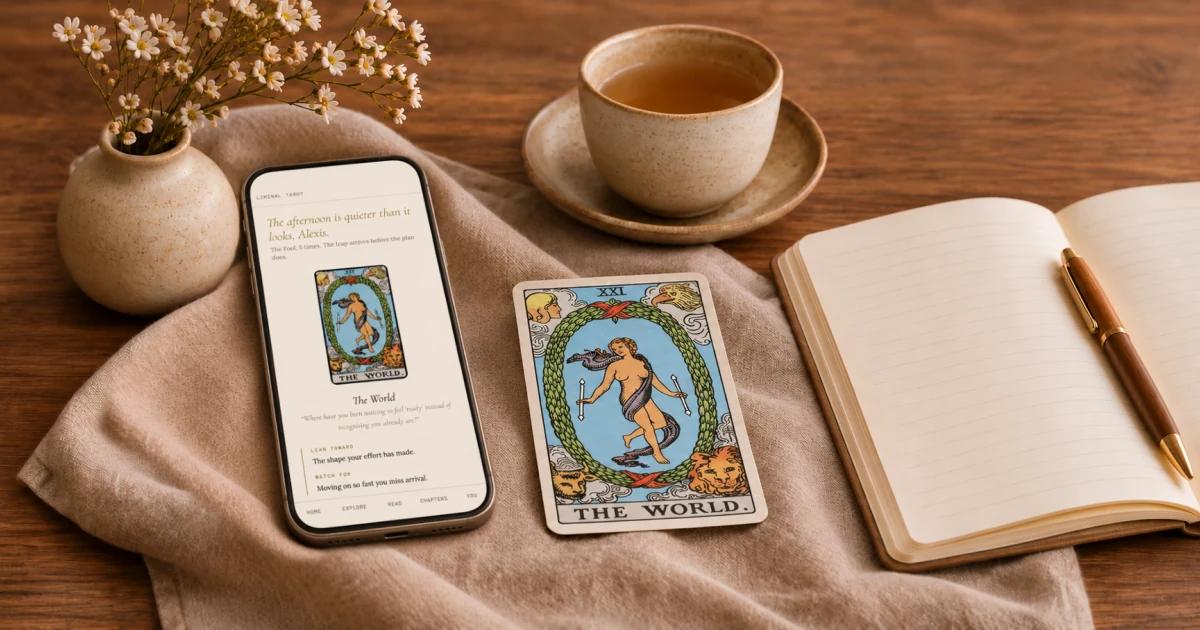
On Monday, you draw the Two of Pentacles and write, Pay attention to what matters. On Tuesday, the Four of Cups leads to almost the same note. Wednesday brings the Eight of Pentacles, and the advice still sounds familiar: Focus on what's important.
Three different cards, one remarkably adaptable sentence.
That sentence may describe something real about your week. But it leaves an interesting question unanswered: what did each particular card contribute? If the same note would make equal sense underneath almost any card, the interpretation may be too broad to show its connection to the draw.
You don't need three radically different messages. A continuing concern may deserve attention on several days. What helps is comparing a small number of entries and looking for a distinction that the card, question, and circumstances can actually support. Sometimes a difference appears. Sometimes the shared theme is right. Sometimes there is nothing more to add.
Key points
- Compare two or three original daily notes with their questions and known circumstances intact, marking any later reading as a revision.
- Try swapping the cards beneath repeated takeaways to see whether each sentence depends on that card's particular image or theme.
- A continuing concern may produce similar advice across different cards; keep genuine overlap instead of inventing distinctions after the fact.
Why different cards can turn into the same advice
Daily questions are often deliberately open. What should I know today? gives a reader freedom to reflect, but also makes it easy to land on advice that could apply in nearly any situation. Words such as balance, growth, change, and trust can be useful starting points. On their own, they rarely explain why one card rather than another prompted a particular thought.
A live concern can narrow the reading in another way. If work is occupying your attention, several unrelated images may all bring you back to work. That doesn't make the concern imaginary. It does mean the concern was already present before you drew the card, and the interpretation needs to be clear about what came from your circumstances and what came from the image.
Polished wording can hide this gap. Find your balance sounds complete. Yet balance between which demands? Is the practical difficulty about coordinating several commitments, deciding whether to accept an option, or giving patient attention to work already underway? Those are different questions, even if you ultimately make the same decision.
There is no need to identify a psychological cause or diagnose a reading habit. You can examine what you wrote without deciding why you wrote it.
Keep the original entry in view
Choose two or three daily entries, ideally ones drawn with the same question. Leave the original notes intact. If you revise an interpretation later, label it as a later reflection rather than replacing what you recorded on the day.
For each entry, you only need the card, the exact question, the original takeaway, and whatever situation you actually knew about at the time. If you remember which detail of the image first stood out, include it. If you don't remember, leave that space blank. A reconstructed first impression is less useful than an honest gap.
Using the same question across entries makes the comparison easier to follow. If one day's question concerned work and another concerned a relationship, the question itself may account for some of the difference. You can still look at the entries side by side; just don't treat it as a comparison in which only the cards changed.
A meaning reference can help you recall a card's possible themes, but it should widen the options rather than supply an automatic answer. If that is where you get stuck, this guide to using looked-up card meanings in a reading explains how to bring a general meaning back to a particular question and context.
Try the card-swap test
Begin with the sentence you keep repeating. Don't improve it yet. Put it beside each card and ask: If I swapped the card for one of the others, would this sentence have to change?
If the answer is no, you have identified a general reflection. It may be reasonable advice, but it doesn't explain the relationship between the note and the particular image. Now return to each card and consider one more constrained possibility. What detail, contrast, or theme could invite a different question here? What is already known from your circumstances, and what is merely a possible interpretation?
Consider this hypothetical three-day journal. The question is the same each morning: What deserves my attention today? The reader already knows that a work week contains competing tasks, an invitation they haven't answered, and a draft that needs revision. The cards do not establish those facts.
- Monday — Two of Pentacles. First note: “I need more balance.” Possible narrower reflection: Two commitments compete for one afternoon. What can I rearrange or defer?
- Tuesday — Four of Cups. First note: “Make better choices.” Possible narrower reflection: I haven't responded to an invitation. Am I declining it, postponing a decision, or simply not interested?
- Wednesday — Eight of Pentacles. First note: “Keep growing.” Possible narrower reflection: The draft is already started. Which part needs another careful pass rather than a new direction?
These are illustrative interpretations, not fixed translations of the cards. The Two of Pentacles can offer an image of managing competing demands. The Four of Cups can invite attention to how an option is being received. The Eight of Pentacles can bring workmanship and repetition into focus. Another reader may notice different features and arrive at other defensible questions.
What matters here is the difference in the kind of reflection. Monday asks about coordinating commitments. Tuesday examines reluctance toward an available option. Wednesday asks what patient revision would improve. All three may belong to the same demanding week without collapsing into the same generic advice.
Now swap the narrower notes. The question about deferring one of two competing commitments does not arise as naturally from Wednesday's workmanship framing. That is a useful sign that the Monday note depended on the interpretation of the Two of Pentacles, rather than just on a sentence that can follow any draw. It is not proof that the card confirmed a decision or predicted what would happen.
If a swap still works, try to name what made it work. Maybe your original note was broad. Maybe the cards reasonably connect to one theme through different details. You do not have to force a distinction to pass the exercise.
When the same message really does fit
A concern can stay in place even while the cards change. You may spend a week deciding how to protect time for an important piece of work. The Two of Pentacles might raise the problem of competing commitments, while the Eight of Pentacles might raise the value of attending steadily to one task. Both could lead to the same practical choice: keep a block of time free.
That doesn't make the entries interchangeable. One reflection names a scheduling tension; the other concerns what you do with the time once you have it. You could write: Different emphasis, same practical next step. You have preserved both the overlap and the card-specific reasoning.
There is also a simpler possibility: no useful distinction appears. You look again and find that the card has not added anything you can honestly name. An entry such as I already knew I needed to finish this draft; no further useful distinction today is complete. More cards are not required to make it feel successful.
If the issue is that one reading merely restates something you already knew, rather than that different daily cards keep receiving the same wording, the contribution test for an obvious reading addresses that related question directly.
Don't invent specificity after the fact
A more detailed note is not automatically a better-supported note. Once you know how the day unfolded, you can make almost any card sound uncannily precise by fitting it to the outcome. The comparison is most useful when you keep what was known at the time separate from what you interpreted later.
For example, there are three distinct layers in Monday's note. You already knew you had two commitments. The Two of Pentacles gave you a possible way to think about how you were handling them. Whether to ask for a deadline change was your practical choice. The card did not reveal the deadlines or authorize the choice.
A quick safeguard is to ask whether you could have written the narrower interpretation before knowing what happened next. If you couldn't, mark it as hindsight. Looking back can still be useful, but a later interpretation should not be passed off as a prediction you made at the time.
And if two cards genuinely support similar reflections, keep that similarity. A contrast exercise can become its own fitting exercise when the reader feels obliged to produce a unique lesson from every draw.
A small journal comparison is enough
Try this with two or three existing notes. Keep the exact question and card beside each original takeaway. Add one line for a possible card-specific detail, then ask whether the takeaway would survive a swap with the other card. If you narrow the note, show that it is a revision. A notebook, a simple table, or a few lines of text will do.
The result can be modest: The theme stayed the same, but the cards raised different parts of it. Or: My first sentence fit every card; this version is narrower, though still tentative. Or simply: I can't identify a distinct contribution from this entry.
Each is an honest result. A daily practice does not need to manufacture a fresh message every morning. It benefits more from keeping clear which parts came from the card, which came from the situation you already knew, and which came from the decision you made afterward.