The Hierophant & Death
What The Hierophant and Death Mean Together
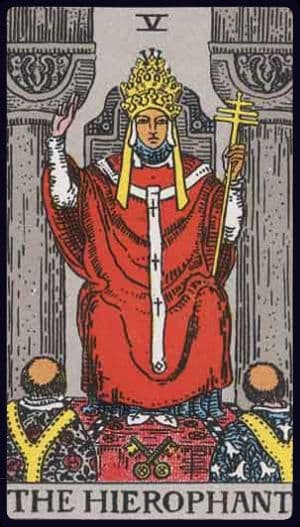
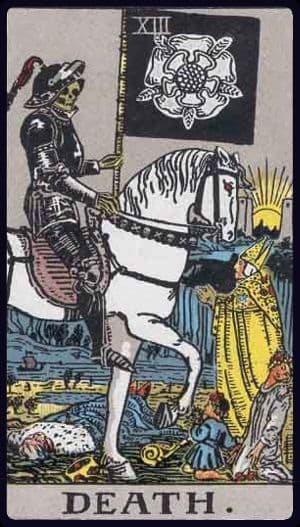
An old script may be ending at the level of identity, not just preference. The Hierophant represents inherited systems of meaning — family values, religious structures, institutional paths, ideas about what a respectable life should look like. Death enters when that framework can no longer carry your real experience. Together, they often reflect deconversion, career reinvention, leaving a marriage model you were taught to idealize, or simply admitting that the rules that shaped you are no longer enough. This pair is unsettling because it asks for loss before clarity fully arrives.
What This Pair Reflects
Consider what belief, role, or code of conduct you may be outgrowing even if it once gave your life coherence. This combination invites you to notice whether you are grieving the end of a framework or merely trying to preserve it out of loyalty.
Begin your practice
Your readings, notes, and questions in one private place.
Start a readingIn Different Situations
Relationships
A relationship can change when the idea of what it should be stops matching what it is. The Hierophant carries the models of love, loyalty and commitment that came from family or community. Death marks the point where an inherited model may have to be left behind. That can feel like failing at something you were taught to protect, even if the people involved are still trying to understand one another. This pairing need not mean the relationship ends. It may be the quieter grief of letting go of a script before you know what kind of commitment could replace it.
Career
What once looked like a respectable career may no longer feel like your own. The Hierophant carries the accepted path: credentials, hierarchy, advancement and other people's definitions of success. Death asks what happens when that path has stopped fitting, even if you worked hard to reach it. This isn't a dismissal of expertise or a sign that you must abandon your profession. It may be the loss of an identity built around being the reliable one, the successful one, the person who followed the plan. Changing direction can involve grief for a future that once made sense.
Decisions
A choice can feel wrong simply because it breaks a rule you've lived by for a long time. The Hierophant holds the family beliefs, social expectations or personal codes that gave that rule authority. Death introduces the possibility that the code itself is changing, not just the decision in front of you. This doesn't make every departure brave or every tradition false. It makes room to ask whether you're protecting a value that still matters or an identity you are afraid to leave. Even a right-fitting change can carry sadness for the life it replaces.
Burnout
Being the dependable one can become exhausting when dependability has hardened into a rule you aren't allowed to question. The Hierophant carries the idea of how a good, capable person is supposed to behave. Death reflects what happens when that identity can no longer be maintained in its old form. The weariness may involve more than too much to do; there can also be grief in no longer being able to live by a standard that once gave you pride. The value behind the rule might remain, even if the role built around it cannot stay the same.
Feeling Stuck
There is a kind of stillness that comes from continuing to perform a role after it has stopped feeling like yours. The Hierophant holds the rules, loyalties, and shared expectations that make the role recognizable. Death marks a change in your relationship to them, even if nothing outward has shifted yet. Staying with the old script may preserve a sense of belonging while leaving very little room for the person you've become. The difficulty may be less about finding a next step than about admitting that the old description no longer quite fits.
New Beginnings
You may be beginning without the old map that once told you who to be. The Hierophant represents the customs, expectations, and sense of belonging that helped define a previous chapter. Death signals a break in that inherited shape. The new space can feel both more your own and less familiar than you expected. You don't have to reject every tradition to recognize that some no longer hold. An emerging way of living may borrow pieces of what came before, but it can't be measured entirely by the rules of a life that has changed.
Grief and Loss
Loss can unsettle the beliefs and customs that used to make life feel coherent. The Hierophant holds the shared rituals, roles, and meanings you may have relied on; Death marks a change those forms cannot simply absorb. Some traditions may offer a place for what you're carrying. Others may feel distant now, even if they once mattered deeply. This is not a demand to find a lesson or replace one belief with another. You may be grieving both what is gone and the familiar way you understood your place around it. Those losses need not resolve together.
Reversed Variations
Both reversed
The structure may be dying slowly while you keep performing allegiance to it. Resistance to change can leave you stuck in a hollow version of faith, duty, or belonging.
The Hierophant reversed
The Hierophant reversed loosens the traditional system first. Transformation remains necessary, but it may feel less like a clean ending and more like a slow separation from borrowed meaning.
Death reversed
Death reversed prolongs the life of the framework past its natural limit. You may keep trying to repair an identity structure that has already stopped feeling alive.