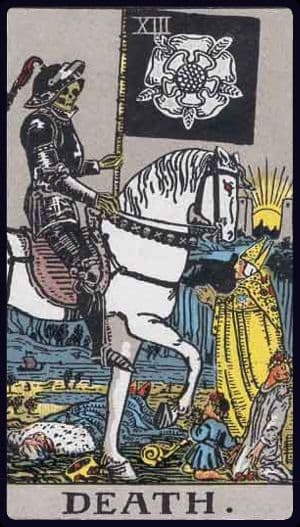
Major Arcana
Death
Death is the card of necessary ending — the threshold where one life shape gives way to another.
Upright
Reversed
Death Meaning
Upright
Death represents endings and transition. In a reading, it invites you to examine what may have reached a limit; it does not establish that a role or relationship must end. It speaks to change that clears space, not change for its own sake: a role, attachment, routine, or version of yourself that cannot keep following you forward. The card marks transformation through release, and often a transition that feels stark only because it is honest. What leaves here matters, but so does what begins once you stop trying to preserve what has already shifted.
Reversed
Reversed, Death often points to resistance to change even when the old structure has already started to loosen. You may be delaying a necessary ending, circling the same threshold, or trying to negotiate with something that is no longer viable in its current form. Sometimes this card describes personal transformation happening inwardly first, accompanied by a quieter kind of inner purging before anything visible changes outside. The work here is less about forcing a reinvention than letting the outdated version of things finish ending.
Death as a Daily Card
Today asks you to face endings with grace. Death clears away what no longer serves you — but only if you allow it.
Lean toward
The grief inside the ending.
Watch for
Rushing to the lesson before the loss.
What part of your life is asking to be composted into something new?
In Different Situations
Relationships
A relationship can change so much that the old way of being close no longer fits. Death names that change without declaring a breakup. An expectation, a familiar role or a pattern of avoiding the truth may be ending even while affection remains. Trying to preserve every part of what came before can make it harder to understand what the relationship is now. There may be sadness in losing a familiar version of closeness, whether or not the people involved part ways. The card leaves the outcome open while taking the change seriously.
Career
Sometimes a career shift begins before a resignation or a new offer. You may still be doing the work well while no longer recognizing yourself in the ambition that brought you there. Death is the ending of a professional shape: an old role, definition of success or direction that has run its course. It doesn't require leaving a job, and it doesn't guarantee that the next phase will be easier. The important loss may be a version of yourself you worked hard to become. Naming that loss makes the change more honest than pretending you're simply ready for something new.
Decisions
Choosing one path often means letting another possible life become unavailable. Death gives that part of decision-making its full weight. The difficulty may not be deciding which option is better; it may be accepting that no choice can preserve everything you hoped to keep. This card does not demand a drastic break. It highlights endings that are already part of the decision, including assumptions or plans that no longer fit the facts. Grieving a possibility does not mean the decision was wrong, and reluctance to release it doesn't make the old path viable.
Burnout
You may be trying to recover enough energy to return to a pace that was never sustainable. Death places the old pace itself under examination. Perhaps a routine, an obligation or the version of yourself who could always manage one more thing is reaching an end. That can bring relief and grief together: even an exhausting identity may have been a source of pride. The card offers no diagnosis and no neat reset. It marks the possibility that relief depends on letting a familiar way of living finish, rather than restoring it unchanged.
Feeling Stuck
Something may feel immovable because the old version of it is still being kept alive. Death is interested in this in-between state: a habit you no longer believe in, an ambition that has gone quiet, a story about yourself you keep repeating out of familiarity. There need not be a visible crisis or a clear alternative. The stuckness can come from treating an ending as if it were still negotiable. That doesn't make change simple, and the card cannot tell you what must go. It gives the fading shape of something a name, which is different from demanding an immediate reinvention.
New Beginnings
A beginning can be welcome and still carry the weight of what ended before it. Death makes that connection hard to ignore. A new role, relationship or season may ask you to leave behind habits that once helped you belong somewhere else. Feeling unsure does not mean the new chapter is mistaken, and excitement does not cancel the loss. The card is less interested in a triumphant fresh start than in the honest passage between two ways of living. Some parts of the past remain meaningful even when they cannot come forward in the same form.
Grief and Loss
Death is a difficult card to see when you're already grieving. It is not a prediction of another death, and it doesn't turn loss into a neat promise of transformation. Here it can name the irreversible fact that a familiar part of life has changed, along with the smaller endings that follow: routines, expectations, the ease of speaking in the present tense. An ending can be real without making attachment disappear. This card leaves room for sorrow that persists, memories that change, and a future that doesn't have to justify what was lost.
Recurring appearance
What does it mean when Death keeps appearing?
What is over may linger past its actual life. Something familiar may no longer fit the same way.
Spreads that work well with Death
Past, Present, Future
3 cardsThe classic three-card arc. Where you've been, where you are, and where the energy is heading.
View spread →New Chapter
5 cardsDesigned for life transitions — starting something new, ending something familiar, or standing in the space between. This spread is Liminal Tarot's signature.
View spread →The Threshold
5 cardsFor moments when you know something needs to change but you can't yet see what comes next. This spread sits with you in the doorway — not rushing you through it, not pulling you back.
View spread →Pairs with Death
Begin your practice
Draw Death in a reading
Context transforms a card's meaning. A full reading weaves your question, your spread, and your cards into a coherent reflection.