When One Card Is Enough: How to Do a Daily Single-Card Practice
Build a daily tarot card practice with one card, a simple question, and a few honest notes. Keep it grounded, consistent, and useful. Try it free.
Aurora @ Liminal Tarot
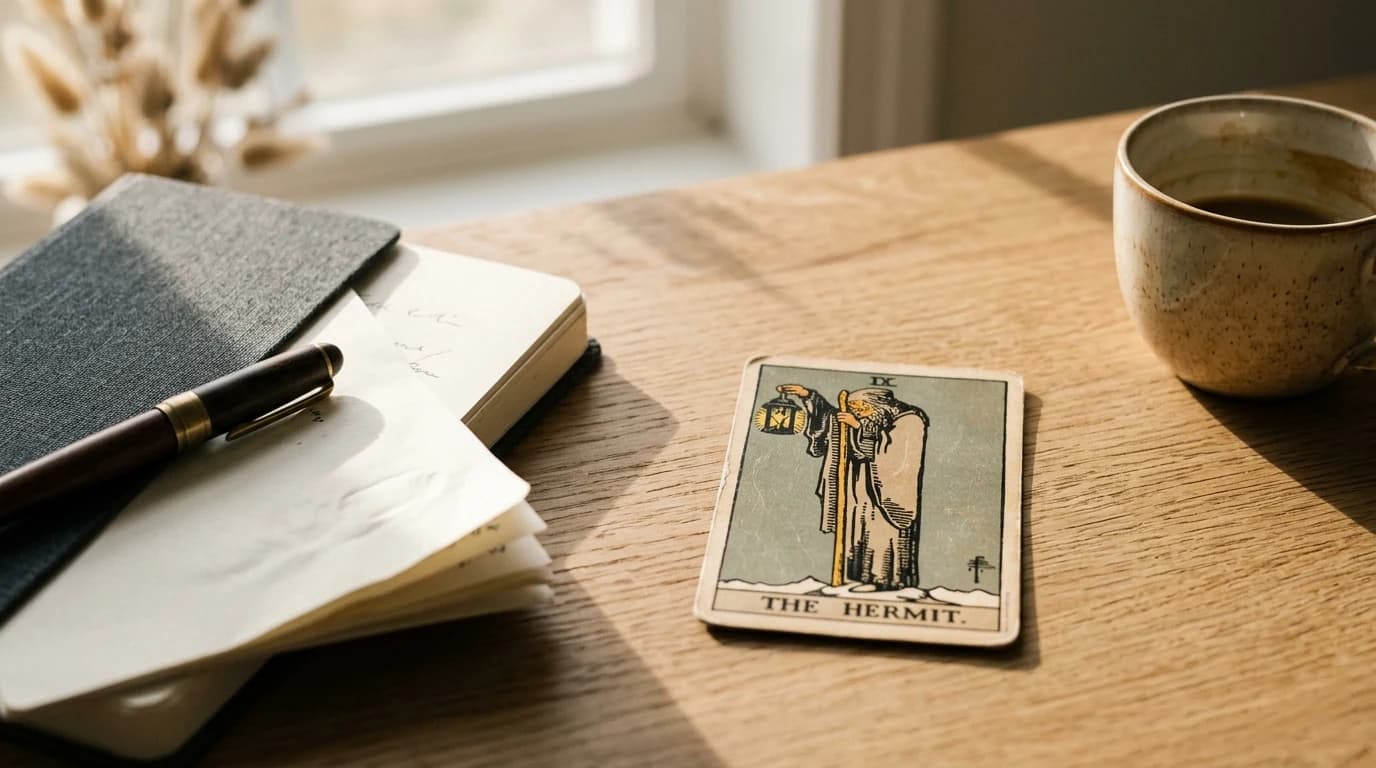
Some mornings you do not need a seven-card spread. You need one clean prompt, one honest pull, and two quiet minutes before the day starts making demands on you.
That is why a daily tarot card practice works so well for people whose lives are already full. It gives you structure without requiring ceremony on command. It is small enough to repeat, but meaningful enough to notice patterns over time.
The mistake many people make is assuming a one-card draw is too simple to be useful. In practice, the opposite is often true. One card leaves less room to over-interpret, less temptation to keep pulling until you get a more flattering answer, and more space to actually sit with what showed up.
In this guide, we will look at when a single-card practice is enough, how to build one that lasts, what to write when you pull your card, and how to keep a daily tarot routine from turning into one more self-improvement chore.
Why a daily tarot card practice works so well
A single-card pull is not the "lite" version of tarot. It is a different kind of practice.
When you work with one card, the question becomes cleaner. Instead of asking the deck to explain everything at once, you ask it to give you one angle, one tension, or one thing worth noticing today. That makes the reading easier to carry into real life.
This is especially useful when your attention is fragmented. If you are heading into work, managing family logistics, or feeling emotionally maxed out, one card is often the most honest container. It respects your actual capacity instead of the fantasy version of you who has forty quiet minutes and a candle already lit.
A one card tarot practice for beginners also builds confidence fast. You are not trying to memorize an entire spread structure. You are learning how to notice your first response, name what the image stirs up, and connect it to the day in front of you.
Try this: For one week, ask the same simple question before every pull: What energy should I work with today? Using one repeated question removes friction and helps you compare the cards more clearly.
How to start a daily tarot card practice without overcomplicating it
The best practice is the one you can still do on a tired Tuesday.
If you want to know how to start a daily tarot card practice, keep the setup almost aggressively simple. Choose a time, choose a question, and choose where the reflection will live. That is enough.
Step 1: Pick a repeatable moment
Do not wait for the perfect ritual mood. Attach the pull to a moment that already exists.
For some people, that is with coffee before opening email. For others, it is on the train, after lunch, or before bed when the day has finally stopped shouting. The exact timing matters less than consistency.
One reader might keep a deck on the kitchen table and pull a card while the kettle boils. Another might use a digital draw at 11:30 p.m. because that is the first quiet moment they get. Both count. Both are real practice.
Try this: Write down three moments in your current day when a one-minute pause is realistic. Pick the easiest one, not the most aspirational one.
Step 2: Use one reliable question
A good daily question is open enough to invite reflection but focused enough to keep you from spiraling.
A few strong options:
- What energy is most present for me today?
- What should I pay attention to today?
- What am I bringing into today without realizing it?
- Where would steadiness help me most today?
This is where a tarot one card spread quietly shines. The structure is simple enough that the card becomes the mirror, not the puzzle.
Try this: Stick with one question for at least seven days before changing it. Repetition makes the differences between cards more revealing.
Step 3: Decide what you will record
You do not need a full journal entry every time. A sentence or two is enough if it helps you return later.
At minimum, record:
- the card
- your question
- your first reaction
- one line about how it might apply today
That is the whole skeleton of a sustainable daily tarot routine. Pull, reflect, record, continue.
Try this: Give yourself a hard cap of three lines for the first week. Small logs are easier to maintain than ambitious ones you silently abandon.
What to do after you pull the card
The useful part of tarot is not just drawing the card. It is what happens in the minute after your first glance.
Many practitioners notice that the first interpretation is often either too abstract or too dramatic. The card feels important, so the mind starts performing. A better move is to slow down and ask grounded follow-up questions.
Start with observation, not interpretation
Before you ask what the card means, ask what you notice.
What emotion do you have looking at it? What image pulls your attention first? Does the card feel familiar, resistant, reassuring, irritating? That first layer is often more revealing than a polished explanation.
If you pulled the Five of Pentacles before a stressful meeting, you might immediately think, Great, this day will be terrible. But if you pause, you may realize the card is highlighting your fear of exclusion or scarcity, not predicting disaster. That changes how you move through the day.
Try this: Complete the sentence: The first thing I notice about this card is... Then stop there before reaching for a guidebook.
Ask one practical question
After the emotional reaction, bring the card into contact with your actual day.
Ask:
- Where does this already feel true?
- What would it look like to respond well to this energy?
- What is the smallest action this card seems to invite?
Say you pull Strength on a day packed with hard conversations. The useful reading is not "I am powerful now" in some vague inspirational sense. It might be: Stay calm when you feel the urge to react fast. That is specific enough to use.
Try this: Translate the card into one behavioral sentence beginning with "Today I can..."
Leave some room for revision
A single-card reading does not need to be solved at 8 a.m.
Sometimes the meaning lands later. The Hermit might make more sense at 10 p.m. than it did before breakfast. The point is not instant mastery. The point is building a relationship with your own pattern of response.
Try this: Revisit the card in the evening and add one line: Now that the day happened, this card feels like it was pointing to...
How to keep the practice consistent when motivation drops
Consistency rarely fails because people do not care. It fails because the practice has too much setup, too much guilt, or too much imagined significance.
If your daily tarot card practice starts feeling heavy, reduce the ritual before you abandon the habit.
One person stops because they think every reading has to be deep. Another stops because missing two days makes them feel like they have "broken the streak." A healthier model is to treat the practice as a returnable rhythm, not a purity test.
Make the floor lower
Your minimum version should be almost laughably easy.
Pull one card. Name it. Write one sentence. Done.
On better days, you can do more. But your baseline should be light enough that stressful weeks do not wipe it out completely.
Try this: Define your minimum practice in advance using this formula: One card + one sentence + under two minutes.
Expect unevenness
In practice, a stable ritual still has seasons. Travel disrupts it. Illness disrupts it. Big life events disrupt it. That does not mean the practice failed.
A good reflective practice bends with reality. It does not require ideal conditions to count.
For example, someone going through a breakup might pull daily for two weeks because the structure helps, then disappear for ten days because they are exhausted. Coming back with one card is still part of the practice. It is not starting over from zero.
Try this: Replace "I need to get back on track" with "I am returning to the rhythm." Language matters more than it seems.
Let repetition teach you
The compounding value of a single-card practice is not in any one dramatic pull. It is in the accumulation.
After a month, you may notice you keep drawing cards that reflect boundaries, rest, or indecision. After three months, you may notice that certain cards appear during specific work cycles or emotional states. This is where tarot stops feeling random and starts feeling like a pattern-recognition tool.
Try this: At the end of each week, scan your entries and ask: What themes kept repeating, even when the cards were different?
When one card is enough — and when it is not
A single-card practice works beautifully for orientation. It is excellent for daily reflection, emotional weather checks, and small course corrections.
It is less useful when your question has multiple moving parts. If you are trying to understand a complicated relationship dynamic, a career crossroads, or a situation with conflicting motives, a larger spread may give you the context a single card cannot.
That is not a failure of the method. It is just spread selection. One card is enough when the goal is contact, clarity, or daily steadiness. A larger spread is better when the goal is mapping complexity.
Many readers benefit from making one-card pulls their default and using broader spreads only when a question genuinely needs more structure. That keeps tarot integrated into everyday life instead of reserved for moments of crisis.
Try this: Ask yourself before every reading: Do I need orientation or complexity right now? If the answer is orientation, one card is probably enough.
A daily single-card practice is simple, but it is not shallow. Done well, it becomes a way of meeting yourself repeatedly, in small honest increments, without waiting for the perfect mood or the perfect question.
If you want a low-friction way to make that rhythm easier to keep, Liminal Tarot's Daily Card Pull gives you a grounded one-card ritual you can return to each day. You can also explore our one-card spread guide, read more about the single card tarot pull, or pair the habit with a gentle morning tarot ritual.