The Psychology Behind Tarot: Why Archetypes Work Even When Magic Doesn't
Explore the psychology of tarot and why archetypal cards can unlock insight, even if you don't believe anything supernatural is happening yet.
Aurora @ Liminal Tarot
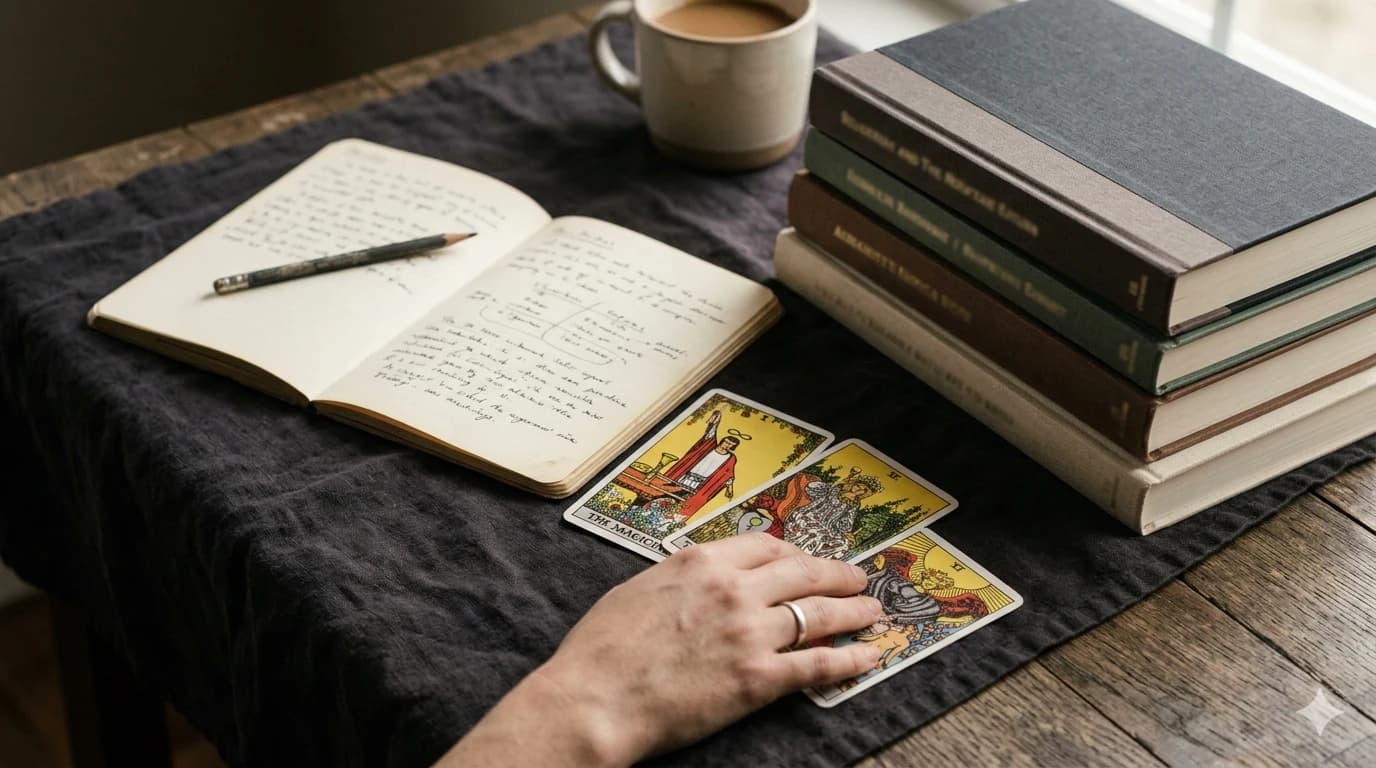
You shuffle, pull a card, and somehow it lands on the exact theme you've been avoiding all week. Not because the universe faxed you a prophecy, necessarily. More because the card gave your mind something solid to react to. That reaction is the interesting part.
The psychology of tarot starts there: not with supernatural certainty, but with the way symbols, stories, and patterned imagery help you recognize what already has your attention. If you've ever felt drawn to tarot while also rolling your eyes at the mystical packaging around it, you're in good company. A lot of thoughtful practitioners use tarot less as a prediction machine and more as a structured prompt for self-inquiry.
This is where tarot and psychology overlap. The cards offer archetypes, tension, conflict, desire, collapse, hope, ambivalence. You bring the living material of your actual life. Put those two together and you often get clarity. If you need a basic grounding first, our guide to what tarot is is a useful starting point.
Archetypes work because human experience repeats itself
Carl Jung did not build a tarot system, but his writing on archetypes helps explain why tarot imagery can feel uncannily relevant. Archetypes are recurring human patterns: the beginner, the caretaker, the rebel, the destroyed structure, the hard lesson, the leap into uncertainty. You see them in myths, novels, films, religion, therapy language, and ordinary life.
That is a big part of why tarot archetypes meaning holds up even for skeptical readers. The cards are not describing one niche belief system. They are describing recognizable states of being.
Take The Fool. In practice, people often meet this card when they are standing at the edge of something new: a job search, a move, a relationship that could become serious, a version of themselves they are not fully ready to claim. The card does not have to “predict” anything to be useful. It names the emotional territory of beginning.
Now compare that with The Tower. Most people react to it instantly. You do not need a guidebook to feel what is happening in the image: collapse, shock, the failure of a structure that once looked solid. That recognition is psychological before it is interpretive.
Try this: think of one card that reliably gets a strong reaction out of you. Before looking up a formal meaning, write down three words for what the image makes you feel. Then ask: where is that pattern already alive in my life?
Tarot gives projection somewhere useful to land
One reason why tarot works for reflection is that it creates a safe surface for projection. You look at an ambiguous symbol and your mind starts filling in the blanks. That is not a bug. That is the mechanism.
Psychologists have long been interested in what people reveal when they respond to open-ended prompts. Tarot is not the same as a clinical projective test, and it should not be treated as one, but it does invite a similar move: you see the image, then you tell on yourself a little.
Say you're deciding whether to leave a stable but draining job. You pull the Eight of Cups and immediately think, “Well obviously that's me wanting to walk away.” Someone else might read the same card as avoidance, grief, or overdue honesty. Your first reaction matters because it shows where your mind is already leaning.
This is one of the strongest links between tarot and psychology. The cards are ambiguous enough to invite interpretation, but structured enough to keep the reflection from turning into total free association. You are not staring at a blank page. You are responding to a bounded symbol set.
A useful exercise here: after pulling a card, answer these three prompts before you interpret anything formally.
- What was my first emotional reaction?
- What story did I immediately start telling about this card?
- What might that story say about what I want, fear, or expect?
That short sequence turns a reading into self-observation rather than performance.
The deck gives you a language for inner conflict
A lot of people come to tarot in moments when pure analysis has stopped helping. You have already made the spreadsheet. You have already talked to your friends. You have already argued with yourself in circles. What you do not have is language for the contradictions.
Tarot helps because it externalizes internal conflict. Instead of saying “I'm overwhelmed in a vague way,” you might suddenly see your situation as The Hermit versus The Chariot, withdrawal versus momentum. Or Two of Swords versus Ace of Wands, indecision versus ignition. The cards let different parts of your experience sit next to each other where you can actually examine them.
That is a core piece of the psychology of tarot that gets missed when people reduce the practice to belief. The value is not that the cards know more than you do. The value is that they help you think in symbols, tensions, and patterns rather than in a single flat narrative.
Consider a composite example. Someone keeps saying, “I just need clarity about my relationship.” But in the reading, every card they respond to is really about self-trust, not romance. The apparent question and the real question split apart. Tarot often reveals that kind of mismatch fast.
Try this with your next reading: instead of asking “What will happen?” ask “What tension am I actually inside?” Then pull one card for each side of that tension. Name both honestly. That alone can be more useful than chasing certainty.
Repetition is part of the design, not proof of magic
People sometimes assume tarot feels accurate because the meanings are broad enough to fit anything. Sometimes that criticism is fair. Lazy interpretation does exist. But broad symbolic systems are not automatically empty. They can be powerful precisely because they map recurring human experiences.
Love, fear, shame, appetite, loss, ambition, rest, betrayal, repair, confusion, hope. These are not rare states. They are the stuff of ordinary life. A well-built symbolic system will keep returning to them because people keep returning to them.
That is also why tarot archetypes meaning becomes clearer over time. At first, a card can feel generic. Six months later, after repeated readings and actual life experience, the same card starts to feel specific. Not because it changed, but because your relationship to the pattern deepened.
Many practitioners notice this with recurring majors. The first time you pull The Tower, you may think only of catastrophe. Later you start to see its sharper truth: not random disaster, but the collapse of what was already unstable. The same card becomes more psychologically precise as your practice matures.
A practical prompt for this section: think of a card you used to dislike or misunderstand. What did you originally think it meant? What does it mean to you now? The difference often reveals your own development more than the card's.
You do not have to believe in magic to use tarot well
This is the part many people need explicit permission to hear. You can use tarot seriously without making grand claims about how it works.
You might think of it as a symbolic reflection tool. You might think of it as guided journaling with images. You might think of it as a ritual container that helps your attention settle long enough to hear yourself think. All of those are valid.
What matters is whether the practice helps you notice something true, ask a better question, or approach your life with more honesty. That is a grounded answer to the question of why tarot works for so many people who are not interested in fortune-telling.
In practice, the strongest readings are often the least theatrical. You pull a card. You feel resistance. You realize why. You write down the thought you were trying not to have. That is the moment. Not spectacle. Recognition.
So if tarot has been pulling at your attention while the mystical framing pushes you away, you do not have to choose between cynicism and total belief. You can approach the cards as archetypal prompts and let the usefulness prove itself in experience.
The real test is simple: does a reading leave you more honest with yourself than you were ten minutes earlier? If yes, something meaningful happened. Whether you call that symbolism, projection, archetypal resonance, or the psychology of tarot matters less than the fact that it helped.