How to Read Difficult Tarot Cards Without Turning Them Into Bad News
Difficult tarot cards can stay difficult without becoming predictions. Use question, position, scale, context, and known facts to read them with proportion.
Aurora @ Liminal Tarot
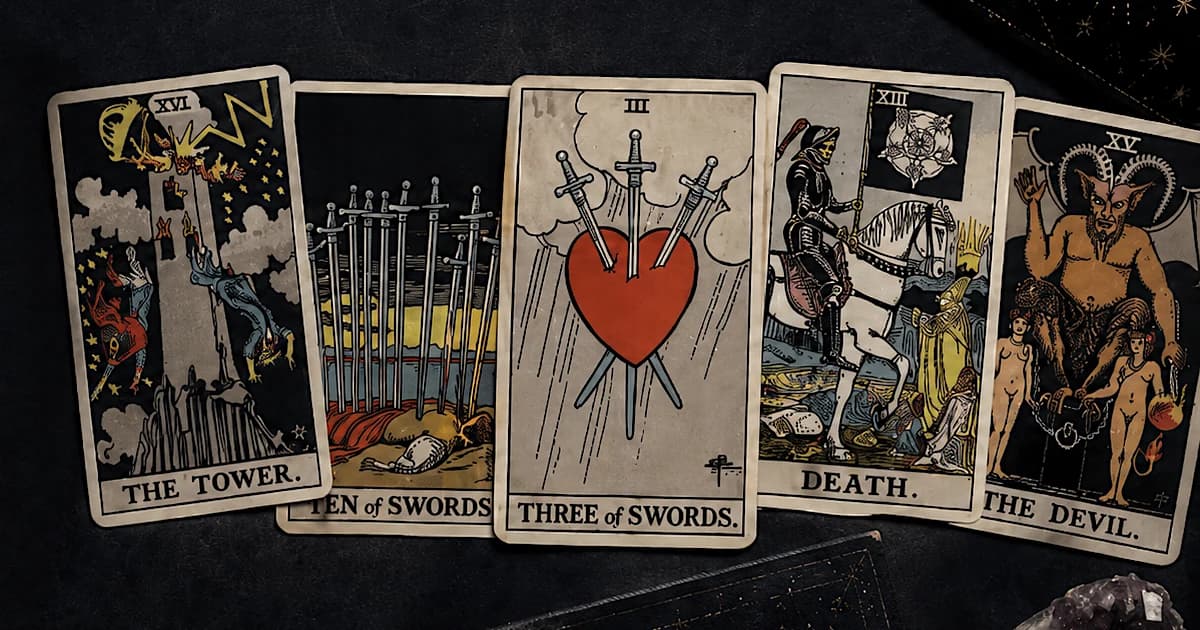
A difficult card can make a reading expand faster than the facts.
Death becomes literal death. The Tower becomes a disaster waiting to happen. Ten of Swords becomes proof that everything is ruined.
The opposite reaction can flatten the reading just as quickly. Death is reduced to transformation, The Tower to liberation, Ten of Swords to a fresh start. The card is made reassuring before anyone has worked out what it is actually doing in the spread.
Both moves skip interpretation.
A stronger rule is simpler: take the card seriously without giving it more certainty than the reading can support. The image can be intense. The situation can be difficult. Neither fact tells you, by itself, what will happen next.
The image supplies intensity. The reading still has to supply grammar.
Separate the card's force from what it can actually establish
Four things tend to get collapsed when an alarming card appears: intensity, category, scale, and certainty.
Intensity is the force of the image. A burning tower or a body beneath ten swords lands hard before you have said a word about the question.
Category is the kind of difficulty the card may be describing: ending, rupture, instability, defeat, exhaustion, finality, exposure, transition.
Scale is how much of the real situation that category applies to. An ending might concern one assumption, one strategy, one role, one relationship, or a longer life chapter. A rupture might be an uncomfortable correction, a failed plan, a disclosure, or a larger structural change.
Certainty is what the reading can actually support. A card can give you a useful interpretation or hypothesis inside a reflective practice. It does not turn an unknown future event into a known fact.
That last distinction matters most. If a contract has already ended, a relationship has already been broken off, or a project has already failed, a difficult card can help you interpret a known situation. That is different from using the card to announce an ending that has not happened.
A useful reading keeps those four variables separate long enough for context to do its work.
Let the question and position set the card's job
When a dramatic card appears, do not let it rewrite the question.
Suppose you asked:
What am I overlooking in this project plan?
and The Tower appears in a blind-spot position. The card's job is to help you examine what may be unstable, exposed, or poorly supported inside the plan. The question has not suddenly become “What disaster is coming?”
The spread position narrows the job again. A card in obstacle asks what is creating friction or limiting movement. A card in what to release asks what may have reached a limit. A card in past can often be more concrete because the relevant events may already be known.
Outcome positions need particular care. “Outcome” is easy to read as “guaranteed future.” A grounded reading treats it as a conditional direction: if the current pattern continues, what might this be moving toward? A difficult outcome card can describe a trajectory worth examining without making that trajectory inevitable.
The same card can therefore do different work in different positions. Ten of Swords in “what to release” may point toward an exhausted strategy or grievance. Ten of Swords in “external influence” may describe an outside condition already marked by strain or finality. The card did not change. Its grammatical role did.
Scale is where bad news often gets inflated
Strong imagery invites the largest possible interpretation. Scale gives you a way to resist that jump without automatically choosing the nicest answer.
Think of four rough levels:
- Local: one task, assumption, conversation, habit, or part of a plan.
- Pattern: a repeated strategy, role, dynamic, or way of responding.
- Domain: a meaningful change within work, relationship, home, money, identity, or another life area.
- Chapter: a larger period of life that is genuinely ending, reorganizing, or changing.
The rule is not “always choose the smallest reading.” That would be another form of denial.
Choose the smallest scale that fully explains the known situation and the spread. Move larger only when the context earns it.
If a company closure has already been announced, The Tower may reasonably operate at a chapter-level scale because the real-world situation is already large. If the question concerns one presentation next week, reading the same card as the destruction of an entire career is an unearned jump.
A simple way to check yourself is to separate known from interpreted.
Known: the team missed two deadlines. A critical dependency failed. The relationship has been paused. The application was rejected.
Interpreted: this structure may be unstable. This approach may have reached its limit. A transition may already be underway. The reader may be resisting an ending they can already see.
The card belongs in the second group. If an interpretation starts migrating into the first without evidence, stop and look at what you added.
Three difficult cards, read with proportion
Tarot traditions vary, and no single keyword list is universal. The three cards below are worked examples rather than fixed definitions. Their familiar ranges make the method easier to see in practice.
Consider Death, The Tower, and Ten of Swords.
Death: an ending does not tell you which event ends
Imagine the question:
What is changing in how I approach this job?
The position is what is ending, and Death appears.
The catastrophic reading is immediate: “I'm going to lose my job.”
The forced-positive reading moves just as fast: “This is wonderful. It only means transformation.”
Neither answer has earned its specificity.
A bounded reading sounds more like this: the current way you relate to the job may be reaching an end. That could concern a role, expectation, identity, routine, or reason for staying that no longer works in the same form. The reading supports an ending or transition theme. It does not establish dismissal, resignation, or another specific event.
Now add known context. Suppose you have already accepted a different role inside the same company. The reading can become more specific because the transition is real: the old role identity is ending, and the useful question becomes what should be released as the new role begins.
The extra certainty came from reality, not from the card.
The Tower: structural disruption is not the same as catastrophe
Now return to the project question:
What am I overlooking in this plan?
The Tower appears in blind spot.
“The plan will collapse” turns a blind spot into a forecast. “Everything will fall apart so something better can rebuild” adds a promised redemption the reading has not established.
A more disciplined interpretation stays close to structure. The plan may contain an assumption or dependency that is less stable than it appears. What would have to fail for the plan to need rebuilding? Is that vulnerability already visible?
At small scale, the weak point might be one deadline, one vendor, one missing conversation, or one assumption about demand. At larger scale, it might be the plan's premise. The image does not choose between them by dramatic force. The known situation does.
That gives the reader something concrete to inspect without pretending collapse is inevitable.
Ten of Swords: finality needs a defined scale
Suppose the question is:
What am I not accepting about this project?
The position is what to acknowledge, and Ten of Swords appears.
“Everything is ruined” has no defined scale. “The worst is over, so this is actually hopeful” can skip the difficult material before it has been named.
A bounded reading might be: one approach to this project looks exhausted or finished. Are you still trying to revive a path that has already given you enough evidence that it cannot continue in the same form?
The thing that has ended may be a strategy, partnership, timeline, or assumption. The wider project remains a separate question.
If the project has actually been cancelled, the scale changes because the fact is already known. The card can then help you reflect on finality, disappointment, or aftermath. It still did not predict the cancellation.
The better reading is not automatically softer. It is better constrained.
Surrounding cards can narrow a reading, not turn it into proof
Nearby cards can make one interpretation more coherent than another. They can reinforce themes of ending, conflict, rebuilding, rest, decision, continuation, or pressure. They can also redirect scale: what first looked like a whole-domain reading may fit one relationship dynamic or one practical problem better once the rest of the spread is considered.
What surrounding cards cannot do is turn an unknown real-world fact into a known one.
Three severe cards are still not proof of an accident, death, breakup, firing, financial loss, or another specific event. A cluster can justify taking the reading seriously. It can make a difficult thematic interpretation more coherent. It does not remove the evidence boundary.
This is the same broader limit covered in what tarot doesn't predict: the reading can shape reflection around a situation without replacing the information the situation itself requires.
Clarifying cards need a specific job
A difficult card often creates an immediate impulse to draw again.
A clarifier can help when the ambiguity is specific. “What part of the plan is unstable?” gives another card a defined job. So does “What aspect of this strategy has reached its limit?” or “What am I being asked to release?”
A clarifier is doing something different when the real question is “Is The Tower really bad?”, “Are you sure?”, or “Can I get a better outcome?” Those draws are not narrowing the interpretation. They are reopening it because the first answer felt uncomfortable.
Before you pull another card, name the unresolved interpretive question in one sentence. If you cannot, the original reading may already be complete.
The same principle applies when a question is drawn again and again. When you keep asking tarot the same question, the useful comparison starts with what changed around the question, not with which spread finally feels reassuring.
Difficult can still mean difficult
A non-predictive reading does not need to become cheerful.
Sometimes the relationship has ended. The job has been lost. The plan failed. The rejection arrived. The conflict is real. In those situations, a severe card may fit the known scale because the situation itself is severe.
The reading can say that an approach is exhausted, a structure failed, an ending is real, or a chapter has closed when those facts are already established.
The important question is where the certainty came from.
The fact comes from reality. The tarot interpretation helps you examine the fact.
That is why forced reassurance is not a useful correction to catastrophe reading. Death does not have to become “growth.” The Tower does not have to become “liberation.” Ten of Swords does not have to become “a new beginning.” Those readings may fit some contexts, but making them compulsory removes information just as surely as panic adds information.
Responsibility is not optimism. It is proportion.
The same boundary matters when the unknown is high stakes. A tarot card should not be treated as evidence establishing physical safety, medical status, a legal outcome, financial certainty, or another consequential fact. The reflective question can remain with what is visible: what information is missing, what assumption is being made, what part of the situation is actually within reach. The real-world fact still needs the evidence source appropriate to it.
A compact method to use in the moment
When a difficult card appears, you do not need a longer list of meanings. You need a sequence that keeps the reading attached to its actual evidence.
- Restate the original question. Use the wording you had before you saw the card.
- Translate the position. What job is this card performing here: obstacle, advice, past, blind spot, what to release, possible direction?
- Name the category. Ending, rupture, instability, exhaustion, conflict, exposure, finality. Keep it broad before inventing an event.
- Calibrate the scale. What is the smallest concrete thing that fully carries that category in the known situation? Move larger only when the context requires it.
- Generate two or three hypotheses. Each one should answer the question and position. Eliminate the ones that depend on facts nobody has.
- State the interpretation and its boundary together. “This may point toward ________. It does not establish ________.”
Then stop.
If the interpretation is coherent and the unresolved part can only be answered by inventing facts, more symbolism will not turn that missing information into certainty.
A difficult card may still be difficult when you finish. Something may be ending. A structure may not hold. An effort may be exhausted. You do not need to erase that.
Keep the intensity. Earn the specificity. Stop before symbolism becomes certainty.