What Happens When the Same Tarot Card Keeps Showing Up
Repeating tarot cards meaning becomes clearer when you track context, not omens. Learn what the pattern may be showing you fully. Read the guide.
Aurora @ Liminal Tarot
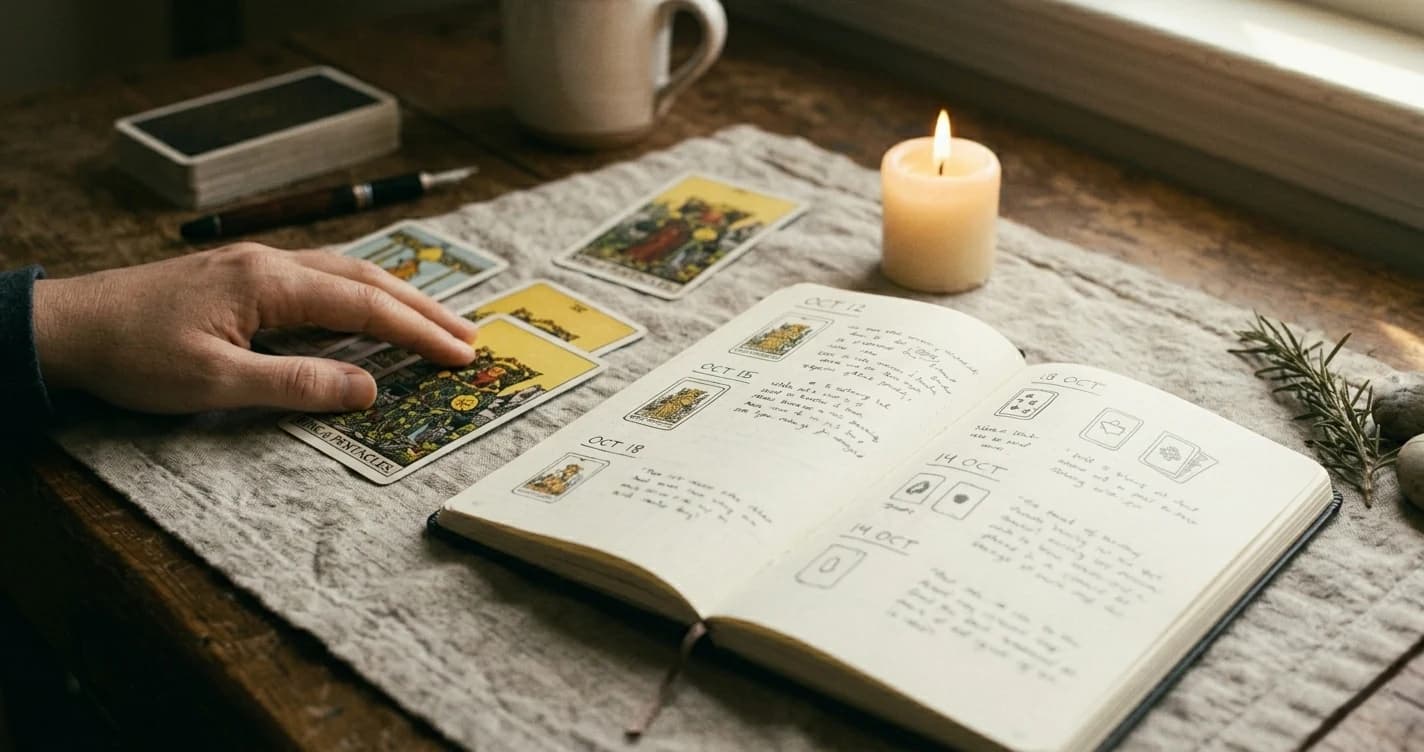
You shuffle properly. You reset the deck. You ask a different question. Then there it is again: the same card, staring back at you like it knows something you do not. That moment is exactly why people go searching for repeating tarot cards meaning. It feels too specific to ignore, but most explanations swing straight into fate, warnings, or mystical certainty.
Our take is simpler and more useful. Usually, the card is not chasing you. Your attention is circling a live theme, and the card keeps giving that theme a shape. Sometimes that shape is obvious. Sometimes it takes three or four readings before you can admit what it is really about.
This guide breaks down why the same tarot card keeps appearing, what repetition actually can and cannot mean, how to tell the difference between a real pattern and random noise, and what to do next if you want the repetition to become insight instead of superstition.
Why a tarot card showing up repeatedly feels so intense
A repeated card lands differently from a one-off pull because repetition creates pressure. It makes the reading feel less like a passing impression and more like an unfinished conversation.
In practice, people usually react in one of two ways. Either they assume the deck is delivering a dramatic message, or they get suspicious and start pulling extra clarification cards until the whole reading turns muddy. Neither response is very helpful.
What many practitioners notice is that a tarot card showing up repeatedly often reflects one of three things:
- an issue that has not actually changed, even if the surface details have
- a lesson you understand intellectually but have not integrated yet
- a pattern in your attention, where the card names the lens through which you keep viewing the situation
Take the Eight of Swords. Someone might pull it in three readings across a month and decide the universe is warning them. A more grounded read is that they are still narrating their situation through helplessness, even as real options start to appear. The card is not forecasting doom. It is describing the current mental posture with annoying consistency.
Prompt: After a repeated card appears, pause before interpreting it and write one sentence: “What part of my current situation has not actually changed yet?” Start there instead of asking what the card predicts.
Repeating tarot cards meaning is usually about context, not omen
The cleanest explanation for repeating tarot cards meaning is context. The card keeps making sense because the underlying situation keeps generating the same symbolic material.
That does not make the repetition trivial. It makes it readable.
The Tower appearing once after a breakup may simply capture shock. The Tower appearing again two weeks later, then once more in a reading about work, might suggest something broader: your life is reorganizing faster than your identity can keep up. The repeated card points less to one event than to the structure of the season you are in.
This is why isolated readings can mislead. Without a record, every repeated card feels dramatic in the moment. With a record, you can ask better questions. Was the card appearing in the same spread position? Was it tied to one chapter of life or several? Was it surrounded by similar supporting cards, or did the surrounding story change while the repeated card stayed constant?
That is where tarot pattern recognition over time becomes more valuable than any single interpretation. One repeated card means something. Five readings with preserved context mean much more.
Here is a useful distinction:
The card may be repeating, but the meaning may be evolving
Suppose the Hermit appears again and again during a job search. Early on, it may reflect withdrawal, uncertainty, and the need to step back from noisy advice. A month later, the same card may point to self-trust and independent discernment. Same symbol. Different phase.
That is why “same tarot card keeps appearing” is not really a one-line problem. The question is not only why the card returned. The question is what stayed the same, and what changed around it.
Exercise: Pull up your last three readings and compare the repeated card's neighbors, spread position, and question. Write down one element that stayed constant and one element that shifted.
How to tell whether you are seeing a real tarot pattern
Not every duplicate is meaningful. A shuffled deck has only so many cards. Sometimes repetition is just repetition.
The key is not whether a card appears twice. The key is whether the recurrence forms a pattern when paired with context.
A real tarot pattern usually has at least two of these qualities:
- The same card appears across readings about the same life chapter.
- The card keeps speaking to the emotional center of the question.
- Your own notes show that the issue is still active, unresolved, or changing slowly.
- The surrounding cards create progression rather than pure repetition.
Consider two examples.
Maya pulls the Three of Swords twice in one week while processing the end of a long relationship. That may simply be a fair reflection of fresh hurt. Then she pulls it again a month later in a reading about dating, but this time it lands beside the Star and Page of Cups. Now the pattern is not just heartbreak. It is heartbreak slowly becoming honest tenderness.
Daniel keeps seeing the Seven of Cups in scattered readings about work, money, and friendships. Once he reviews his notes, the common thread becomes obvious: every reading happened during a stretch of indecision and overconsumption of other people's opinions. The repeated card was not mystical. It was diagnostic.
This is where a real tarot journaling practice earns its keep. The journal does not make the cards more magical. It makes your interpretations less flimsy.
Prompt: For the next repeated card, do not ask “Why is this haunting me?” Ask: “What question, feeling, or behavior links the readings where this card appeared?”
What different kinds of repeated cards often point to
There is no universal formula, but patterns do tend to cluster in recognizable ways.
Repeated Major Arcana cards
When a Major Arcana card returns, the repetition often signals a larger developmental theme. Not bigger in a supernatural sense, just broader in scope. The issue may affect identity, values, or direction rather than a single decision.
For example, repeated Justice may point to accountability, clean decision-making, or the need to stop rationalizing an imbalance. Repeated Death often marks an extended transition, where one version of life is ending before the next has stabilized.
Exercise: If a Major Arcana card is repeating, finish this sentence: “This is bigger than today because it keeps touching my sense of ___.”
Repeated Minor Arcana cards
When a Minor Arcana card repeats, the signal is often more practical and situational. It may describe a recurring behavior, emotional habit, conflict style, or resource issue.
Repeated Pentacles cards can point to stability, routine, workload, or material planning. Repeated Swords can reflect mental loops, conflict, clarity, or overanalysis. The specific card still matters, but the repetition usually rewards concrete thinking.
Exercise: Identify whether the repeated card is asking for a practical adjustment, not just an interpretation. What could change this week in your schedule, boundary, or communication style?
Repeated court cards
Court card repetition often gets flattened into “a person is involved,” which is too simple. Sometimes the court card is another person. Sometimes it is the role you keep inhabiting.
A repeated Queen of Wands might describe a person you keep orienting around, but it may also reflect your own recurring need to lead, initiate, or be seen. A repeated Knight of Cups may show up whenever you are tempted by possibility without enough grounding.
Exercise: Ask whether this court card feels more like a person, a posture, or a role. Then support your answer with evidence from the last two readings.
What to do when the same tarot card keeps appearing
Once the pattern is real, the job is not to obsess over it. The job is to work with it.
First, stop trying to force a final answer out of the repeated card. Repetition is usually an invitation to deepen the question, not close it.
Second, narrow the frame. Put the card inside one named life context: job search, reconciliation, burnout recovery, creative block. When you do that, the card usually becomes less eerie and more legible.
Third, track the card over time instead of interrogating it in one sitting. This matters because the meaning often emerges through accumulation. The first appearance gives you a clue. The fourth may give you a pattern. The seventh may reveal what you have been unwilling to name.
If a card feels especially loaded, try this four-step review:
- List every recent reading where it appeared.
- Note the question, spread, and emotional state for each one.
- Circle the phrase or theme that keeps returning.
- Ask what action or acknowledgment the card seems to keep requesting.
That last step matters. Repetition without response turns tarot into rumination.
For someone repeatedly pulling Temperance during burnout recovery, the action might be boring and concrete: fewer inputs, more sleep, slower pacing, less self-interruption. For someone repeatedly pulling the Lovers in a career chapter, the action might be values clarification rather than romance interpretation.
The card is useful when it changes how you relate to the situation, not when it simply startles you again.
Prompt: Write this at the top of your next journal entry: “If this repeated card is asking something of me, it is probably asking for ___.” Keep the answer behavioral, not abstract.
The real point of repetition is recognition
When the same card keeps coming back, the most grounded response is not fear or fascination. It is recognition. Something in your life, thinking, or emotional stance is stable enough to keep generating the same symbol.
That can be frustrating. It can also be incredibly clarifying.
A repeated card does not have to mean destiny. More often, it means the theme is still alive. Once you start tracking the question, the context, and the chapter it belongs to, repetition stops feeling like a spooky glitch and starts functioning like a mirror with memory.
If you want to see whether a repeated card is really a pattern or just a vivid one-off, keep your readings together over time. On Liminal Tarot, your reading history and Chapters make it easier to spot what keeps returning across the same life context, so the insight builds instead of disappearing into separate sessions.