Does Tarot Work? The Question You're Actually Asking
Does tarot work? A grounded answer for skeptical readers exploring whether tarot can still offer insight, clarity, and reflection. Try it free.
Aurora @ Liminal Tarot
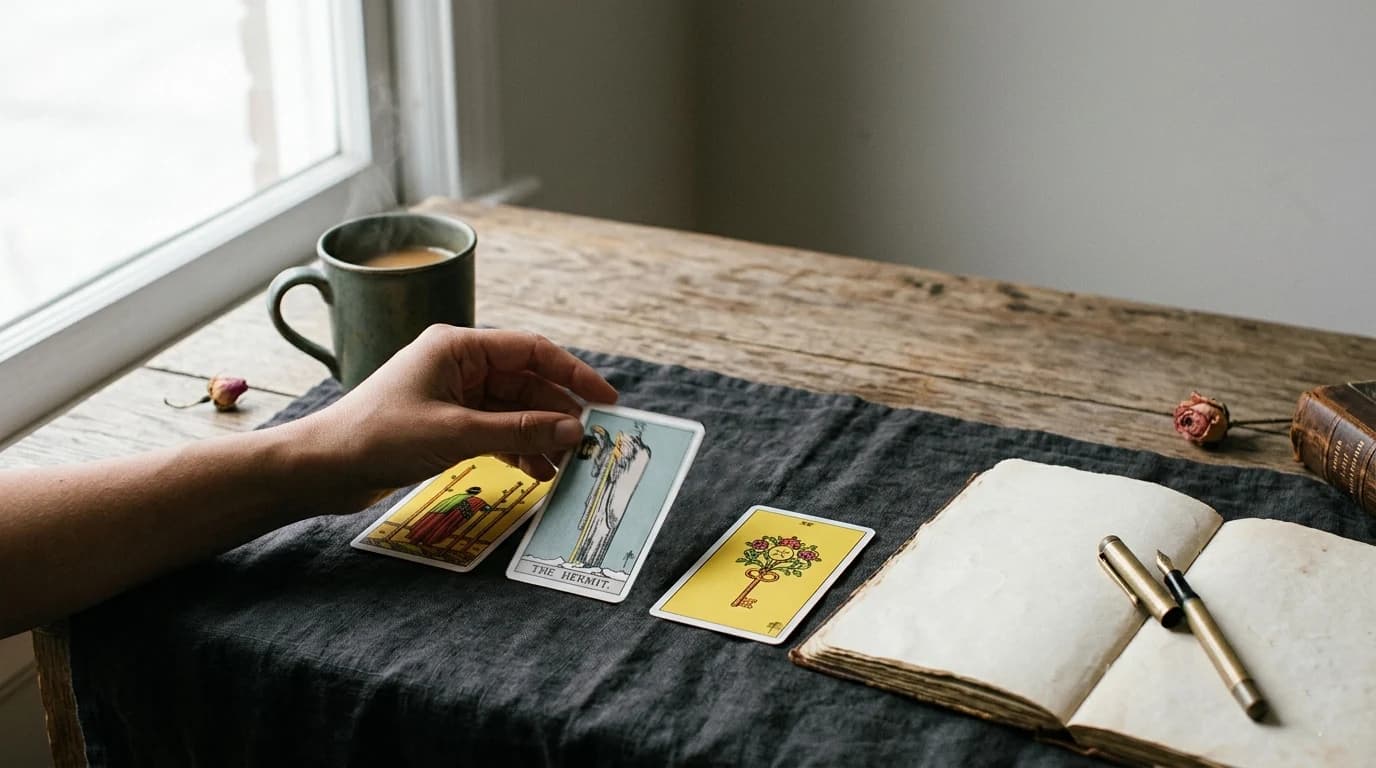
Usually this question does not arrive in a calm, academic mood. It shows up when something in your life is wobbling and you want a clearer view of it. A relationship is changing shape. Work feels wrong but you cannot yet explain why. You pull up tarot with one eyebrow raised and type the most honest version of the search: does tarot work.
That question deserves a real answer, not a sales pitch and not a mystical dodge. The useful response is not “absolutely yes” or “obviously no.” It is: works for what? If you mean perfect prediction, the evidence is thin. If you mean entertainment, symbolism, and emotionally resonant storytelling, often yes. If you mean a structured way to surface what you already know, fear, avoid, or hope, then tarot can be surprisingly effective.
That is the frame Liminal Tarot uses throughout our guide to what tarot is, our piece on the psychology behind tarot, and our article on tarot for skeptics. Tarot does not need to be supernatural to be useful. It needs to help you think more honestly.
“Does it work?” depends on what you want it to do
A lot of confusion comes from using one word, work, for several totally different hopes.
Some people are asking whether tarot can predict the future with reliable accuracy. Others are asking whether it can help them make sense of a messy situation. Those are not the same standard, and tarot performs very differently depending on which one you mean.
If you want a literal forecast of what will happen next Tuesday, tarot is a shaky instrument for that. It is symbolic, interpretive, and shaped by the reader's perspective. It does not behave like a lab test.
If you want a way to interrupt repetitive thinking and notice the emotional truth under your question, tarot is on much stronger ground. A card gives your attention somewhere to land. You react. That reaction becomes information.
Here is a simple exercise that makes the distinction obvious. Write down your current question, then rewrite it in two forms:
- “What will happen?”
- “What am I not seeing clearly?”
Now notice which version feels more workable. Tarot tends to be far more useful with the second question.
Tarot often works as reflection, not revelation
This is the part many skeptical readers recognize immediately once someone says it plainly. Tarot can work because reflection works.
Humans are not great at thinking in a straight line when emotions are involved. We loop. We rationalize. We focus on the detail that supports our preferred story and ignore the rest. An external prompt can disrupt that pattern. Tarot cards happen to be especially good prompts because they are emotionally charged, visually rich, and ambiguous enough to invite projection.
Suppose you ask about burnout at work and pull the Ten of Wands. You do not need to believe the deck received a transmission from the cosmos to get something useful from that moment. The image itself may instantly organize what you already feel: overburdened, carrying too much, trying to prove you can hold it all.
Or say you ask about a relationship and pull Two of Swords. Very often the card does not “tell” you what to do. It reveals that your real issue is avoidance, stalemate, or the cost of refusing to choose. That is not prediction. It is recognition.
A grounded tarot practice leans into that recognition on purpose. After you draw a card, try answering these three prompts before consulting any guidebook:
- What is my immediate reaction to this card?
- What part of my situation does it make me think about first?
- What does that first association say about where my attention already is?
That short sequence is one of the clearest answers to the question of whether tarot works. Often, it works by showing you your own mind in motion.
The strongest evidence is usually personal, not supernatural
When people ask “is tarot real,” they often mean “is there an invisible force making the reading accurate?” That is one possible interpretation, but it is not the only one, and it is not the one you need in order to benefit from the practice.
There is a more modest and more testable standard: after a reading, are you clearer than you were before? Did the card help you articulate something you had not been able to say out loud? Did it change the quality of the questions you are asking?
That kind of effectiveness is easier to observe than metaphysical claims. You can notice it directly in your own life.
For example, someone might come to tarot convinced they need an answer about whether to quit their job. But after a few readings, a different pattern becomes obvious: the deeper issue is not the job itself but the fear of disappointing other people. The reading “worked” if it helped reveal the real decision underneath the stated one.
This is also why keeping records matters. A single reading can feel interesting. Ten readings around the same life situation can reveal a pattern. If the same cards, themes, or emotional knots keep returning, you have more than a spooky coincidence. You have data about your inner life.
Try this as a practical test. For the next week, pull one card a day around the same question and write down three things: the card, your first reaction, and one sentence about what felt true. At the end of the week, review the entries together. Ask: what repeated? what sharpened? what changed?
That review process often answers “can tarot help you” more convincingly than any abstract argument.
Tarot is weak at certainty and strong at better questions
One reason people get disappointed with tarot is that they use it as a certainty machine. They ask for guarantees, fixed timelines, or final answers that will relieve them of responsibility. Tarot is badly suited to that job.
But it is often excellent at producing better questions.
Instead of “Will this relationship work out?” tarot might push you toward, “What dynamic am I participating in here?” Instead of “Should I take the new job?” it might sharpen into, “What part of me wants this, and what part of me is scared of what comes with it?” Those are more demanding questions, but also more useful ones.
That is why tarot can feel accurate without needing to be infallible. A good reading does not always hand you a conclusion. Sometimes it exposes the assumption hidden inside your question.
Imagine someone asking whether they should stay in a city they have outgrown. They pull The Fool, then Eight of Cups. The cards do not produce a legal ruling. What they may do is make it impossible to ignore that part of the person already knows they are standing at a threshold. The reading works because it clarifies the emotional reality of transition.
A useful exercise here is to ask one card, “What am I really asking beneath my question?” Then write for five minutes without editing yourself. That prompt alone can turn tarot from performance into insight.
You do not need belief. You need an honest way in
A lot of people assume tarot only works if you fully surrender to its worldview. In practice, many serious users start from skepticism. They do not want prophecy. They want a structured reflective tool that feels more alive than a blank journal page and less chaotic than thinking in circles.
That is a reasonable standard.
If your bar is “prove to me that the cards contain objective cosmic truth,” tarot may never satisfy you. If your bar is “help me see myself, my choices, and my patterns more clearly,” it has a much better shot.
This is why the best way to test tarot is not to debate it endlessly from a distance. It is to use it in a grounded way and evaluate the outcome honestly. No grand conversion required. No pretending. Just a real question, a card, a response, and a record of what happened.
That is also why a free, low-pressure practice matters. You do not need to commit to a full belief system to see whether tarot is useful in your life. You only need enough curiosity to ask a better question and enough honesty to notice what comes back.
So, does tarot work? Not as a machine for certainty. Not as a replacement for judgment, therapy, or evidence. But as a reflective structure that helps many people name what they already know, especially during difficult seasons, yes. Quite often, it does.
And the question you may actually be asking is not whether tarot is real enough. It may be whether you are allowed to use a strange, symbolic tool if it genuinely helps you think. The answer to that is yes.
If you want to test that for yourself without making a big thing out of it, start with a single draw, respond honestly, and see whether you leave the practice more clear than when you entered it.