Major Arcana
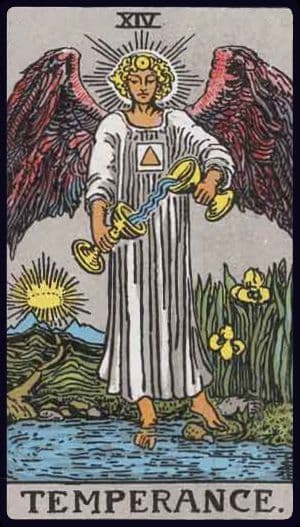
Temperance
Temperance is the card of steady proportion — the art of making different parts of life work together.
Upright
Reversed
Temperance Meaning
Upright
Temperance points to balance that is made, not stumbled into. It often appears when patience matters more than speed, and when moderation is what allows something meaningful to hold. This card is concerned with proportion: how much you give, how much you take on, how carefully you combine instinct with discipline or desire with purpose. Rather than dramatic change, it suggests a quieter process of adjustment until life starts to feel coherent again.
Reversed
Reversed, Temperance can reflect imbalance that has stopped feeling temporary and started shaping your days. There may be excess in one area and neglect in another, or a pattern of overcorrecting each time you sense something is off. At times this card points toward self-healing, but in a grounded sense: noticing what is out of ratio and beginning the slower work of re-balancing. The issue is not perfection; it is whether your current pace and habits can actually support the life you're trying to build.
Temperance as a Daily Card
Temperance heals through balance. Today, check in with your physical, emotional, and mental states. Which one needs attention?
Lean toward
The version that can be sustained tomorrow.
Watch for
Building plans around a temporary surge.
What simple act of self-care would bring you back into balance today?
In Different Situations
Relationships
Closeness rarely means wanting the same amount of time, attention or space. Temperance looks at the work of finding a rhythm that can hold real differences. Its image of liquid moving between cups is a useful one: the point is not to erase what each person brings, but to see what can be combined without either person disappearing. A calm-looking relationship may still be out of balance if one side does all the adjusting. This card gives patience its proper place, alongside the question of whether the effort is shared.
Career
Good work often depends on combining things that don't naturally move at the same speed: ideas and execution, ambition and patience, individual craft and other people's needs. Temperance looks at the proportions. Where does careful work need more room, and where has caution become a reason to delay? It can describe a career built through gradual adjustments rather than one decisive leap. Yet moderation is not automatically a virtue. If the blend requires you to mute every strong idea to keep the peace, the arrangement may be balanced only on the surface.
Decisions
You may be treating a choice as an either-or when the harder question is how competing needs could coexist. Temperance is the art of proportion, not a command to split every difference. Sometimes one priority genuinely needs more weight; sometimes blending approaches would weaken both. The card invites closer attention to what can be adjusted, sequenced or combined without betraying what matters. Its warning is equally useful: endless compromise can conceal an inability to choose. Balance is meaningful only if the resulting decision can actually be lived with.
Burnout
Burnout makes proportion visible when it has been ignored for too long. Temperance is not about performing balance while the same demands remain in place. Its careful transfer between cups asks what actually flows into your days and what keeps being poured out. Perhaps moments of rest are present but too small to offset the effort around them; perhaps every quiet interval gets filled again. The card looks at the ongoing pattern, not a perfect daily routine. Moderation becomes real when the amounts change, rather than when you become better at carrying too much.
Feeling Stuck
When nothing seems to move, a major overhaul can start to feel like the only honest response. Temperance offers a less dramatic possibility: movement through small changes in proportion. One part of life may be taking so much space that another has no chance to develop, even though neither part is wrong on its own. Its quiet work is adjustment and combination, not passive waiting. But there is a limit to tinkering. If every adjustment merely preserves the same deadening pattern, the card's harder side is the recognition that your balance may have become another form of inertia.
New Beginnings
There is a temptation at the start of something to become an entirely different person at once. Temperance works against that sudden swing. Its pouring motion suggests a beginning made by bringing unfamiliar things into contact with what you already know: new routines alongside old commitments, curiosity alongside limits, ambition alongside patience. The mixture may need several attempts before it feels right. This card doesn't guarantee a smooth transition. It values a start that can be integrated into an actual life, instead of one that looks convincing only while everything is new.
Grief and Loss
There may be moments when grief feels close and others when ordinary life takes up the whole afternoon. Temperance can hold both without treating one as a betrayal of the other. Its gentle transfer between vessels is an image of living with different needs at once: remembering, attending to the present, being with people, needing quiet. The proportions will not stay fixed, and no single balance fits every day. This card does not ask for serenity or a measured pace of recovery. It makes room for a life in which sorrow and ordinary activity continue to share space.
Recurring appearance
What does it mean when Temperance keeps appearing?
Daily life may be asking for a steadier mix. Balance keeps asking for adjustment, not perfection.
Spreads that work well with Temperance
Past, Present, Future
3 cardsThe classic three-card arc. Where you've been, where you are, and where the energy is heading.
View spread →New Chapter
5 cardsDesigned for life transitions — starting something new, ending something familiar, or standing in the space between. This spread is Liminal Tarot's signature.
View spread →The Threshold
5 cardsFor moments when you know something needs to change but you can't yet see what comes next. This spread sits with you in the doorway — not rushing you through it, not pulling you back.
View spread →Pairs with Temperance
Begin your practice
Draw Temperance in a reading
Context transforms a card's meaning. A full reading weaves your question, your spread, and your cards into a coherent reflection.