Major Arcana
The Chariot
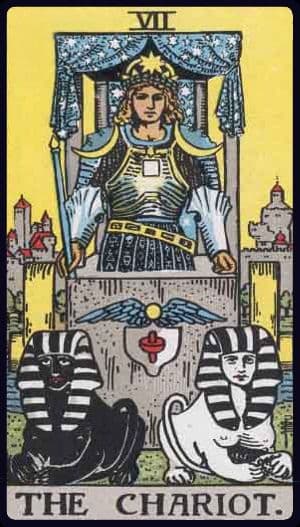
The Chariot is the card of directed will — force that moves forward when intention and effort agree.
Upright
Reversed
The Chariot Meaning
Upright
The Chariot points to momentum that comes from control, not impulse. It appears when willpower, determination, and sustained action are what carry something forward, especially in moments that would otherwise split your attention in too many directions. This card often reflects success, but not the effortless kind; it is the kind earned by staying aligned with a chosen course while pressure, distraction, or conflict pull at the edges. In work, relationships, or personal change, The Chariot asks whether your energy is actually being driven somewhere, or simply spent.
Reversed
Reversed, The Chariot often reflects movement without coherence, or force applied without enough self-discipline to hold it steady. Opposition may be external, but just as often the conflict is internal: part of you pushing ahead while another part resists the cost of commitment. Lack of direction can make effort feel strangely exhausting, as though speed has replaced clarity. At the sharper end, this card can point to aggression — trying to dominate a situation when what is actually missing is steadiness, not more force.
The Chariot as a Daily Card
Today calls for determination. The Chariot doesn't ask if the road is smooth — it moves regardless. Where do you need that kind of resolve?
Lean toward
The part of you that can hold contradiction.
Watch for
Letting one mood take the wheel.
What goal have you been stalling on that deserves your full commitment?
In Different Situations
Relationships
A relationship can have plenty of feeling and still struggle over where it is going. The Chariot is about direction and the effort it takes to keep moving together. It may reflect two people making a deliberate choice to work through friction, rather than expecting closeness to carry them automatically.
It can also expose the strain of one person doing all the steering. More determination does not resolve a difference in pace, and pushing harder can turn commitment into pressure. This card looks at how the connection moves, not just how strongly someone wants it to.
Career
The Chariot belongs to periods when progress requires sustained effort. A clear direction can help you work through setbacks without treating every obstacle as a sign to stop. There is real confidence in knowing what you are aiming toward and bringing your skills into line with it.
Yet career momentum has an awkward side: getting very good at pursuing a goal you no longer question. Determination can shade into competitiveness or a need to win every disagreement. The card gives credit to discipline while asking whether your drive still serves work that matters to you.
Decisions
At some point, weighing a choice and moving with it become different kinds of work. The Chariot brings the second part into view: holding a direction when distractions, doubts and competing demands pull against it. A decision does not become worthless because following through is difficult.
But resolve can also become a way of refusing to reconsider. If you feel driven to choose quickly just to end the uncertainty, the force behind that urgency deserves attention. The Chariot is strongest when the person steering knows both the destination and what they are asking of themselves to get there.
Burnout
The Chariot makes a difficult distinction between endurance and momentum. You can be moving quickly, meeting deadlines and overcoming each fresh obstacle while feeling no closer to where you intended to go. The effort is real. So is the possibility that speed has taken the place of direction.
Its image of holding opposing forces on course becomes strained when every part of you has to be pushed forward. Determination has limits, even when the goal matters. This card does not turn fatigue into failure; it makes visible what constant self-command is costing.
Feeling Stuck
You can push yourself all day and still end up in the same place. The Chariot points to the frustration of effort divided between different directions: one part determined to advance, another pulling back from the cost or the uncertainty.
Its answer is not simply more willpower. Before speed means anything, there has to be a course the competing parts of you can sustain. Sometimes the feeling of being stuck comes from fighting your own resistance instead of understanding it. The card distinguishes a lack of movement from a lack of coherence.
New Beginnings
Newness has its own rush. The Chariot recognizes the energy of finally setting something in motion, particularly after a long stretch of preparing or waiting. A clear direction can turn that early excitement into effort that holds when the novelty wears off.
Yet movement is not the same as having to prove yourself at once. There may be several demands tugging you away from what you intended to begin. This card concerns the art of steering: enough resolve to continue, enough awareness to adjust. The first stretch of the road does not need to become a race.
Grief and Loss
After a loss, staying busy can offer a kind of direction. There are things to organize, people to answer, ordinary days that continue whether you feel ready or not. The Chariot recognizes the effort of keeping yourself moving through that uneven ground.
But movement can become a way of measuring yourself against an imagined timetable. Being capable today does not settle what you miss tomorrow. The card's determination is quieter here: not victory over grief, but the difficult work of steering a life that has changed while allowing the absence to remain real.
Recurring appearance
What does it mean when The Chariot keeps appearing?
Pushing forward can hide a split underneath. Momentum matters, but so does aim.
Spreads that work well with The Chariot
Past, Present, Future
3 cardsThe classic three-card arc. Where you've been, where you are, and where the energy is heading.
View spread →New Chapter
5 cardsDesigned for life transitions — starting something new, ending something familiar, or standing in the space between. This spread is Liminal Tarot's signature.
View spread →The Threshold
5 cardsFor moments when you know something needs to change but you can't yet see what comes next. This spread sits with you in the doorway — not rushing you through it, not pulling you back.
View spread →Pairs with The Chariot
Begin your practice
Draw The Chariot in a reading
Context transforms a card's meaning. A full reading weaves your question, your spread, and your cards into a coherent reflection.