Major Arcana
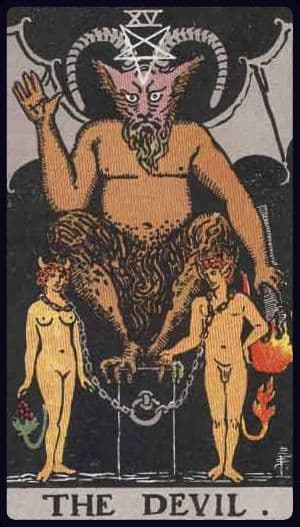
The Devil
The Devil is the card of entanglement — the pull of habits, attachments, and arrangements that can be difficult to change.
Upright
Reversed
The Devil Meaning
Upright
The Devil names attachment in its more persuasive forms: the habit you defend, the dynamic you can explain but not leave, the desire that narrows into compulsion. Its traditional associations include addiction, restriction, sexuality, and materialism, but the card cannot diagnose addiction. As a symbolic lens, it can help you examine an attachment's influence without assuming that every constraint is chosen. This card rarely points to evil in a theatrical sense. It is more often about the quiet arrangements you make with what feels good, familiar, or temporarily relieving, even when the cost is already clear.
Reversed
Reversed, The Devil often marks the beginning of detachment, though not always cleanly. You may be releasing limiting beliefs, noticing where shame has kept something in place, or turning toward dark thoughts that have more power when left unexamined. Sometimes the shift is internal before it becomes visible: the spell breaks in private, then the behaviour follows later. This card suggests that what binds you is becoming easier to name, and once named, harder to keep mistaking for inevitability.
The Devil as a Daily Card
The Devil reveals the chains we choose to wear. Today, examine what habits or attachments keep you feeling stuck — and remember, the chains are loose.
Lean toward
Naming the grip before defending it.
Watch for
Calling a habit freedom because you chose it.
What pattern do you keep repeating even though you know it doesn't serve you?
In Different Situations
Relationships
You can feel deeply attached to someone and still be uneasy about the pattern that keeps you close. The Devil concerns that uneasy pull: jealousy mistaken for care, the comfort of a familiar conflict, or the fear of losing something that has come to define you. None of this proves another person's motives, and the card does not certify that a relationship is harmful or doomed. It makes the attachment itself worth examining. The crucial distinction is between choosing closeness freely and feeling unable to question the terms on which it continues.
Career
A job can give you security, status or a sense of being needed while narrowing what you feel free to question. The Devil is attentive to these bargains. You may keep chasing a measure of success that no longer satisfies, or remain attached to a role because leaving would unsettle how you see yourself. Real financial and practical constraints matter; this isn't a lecture about simply walking away. The card separates those constraints from the extra hold that fear, prestige or habit can acquire, even when the work still has genuine value.
Decisions
Before weighing the options, it may help to notice which outcome already has a grip on you. The Devil draws attention to the relief, approval or sense of control one choice seems to promise. That pull is not proof the option is bad. Desire can reveal what matters, but it can also make costs easier to explain away. There may be real limits on your choices alongside fears that have become larger than the facts. The card doesn't decide for you; it asks whether you're considering the alternatives freely or defending the one you feel compelled to keep.
Burnout
The hardest part of overwork can be the reward it still provides. Being indispensable, meeting another target or getting through one more urgent stretch may offer a brief feeling of safety. The Devil examines how relief and pressure can reinforce each other until stopping feels more threatening than continuing. Not every demand is voluntary, and exhaustion alone cannot establish a harmful dependency. The useful question is where the work's hold has become tied to approval, fear or identity, beyond what the actual circumstances require. Seeing that pattern is different from being able to change it overnight.
Feeling Stuck
A familiar pattern can feel like the only available shape of life, even when it no longer suits you. The Devil turns toward the small bargains that keep it intact: a comfort that numbs dissatisfaction, a rule about who you are, or a fear that makes a different move seem impossible. It would be too simple to say you are choosing all your limits; circumstances can be genuinely restrictive. But the card distinguishes those limits from the ways familiarity acquires its own force. Stuckness can become less mysterious when the attachment underneath it is visible.
New Beginnings
A fresh start doesn't automatically free you from an old pattern. The Devil is especially useful when a new opportunity carries the same powerful appeal as something you thought you'd outgrown: the need to impress, the fear of being left out, the comfort of giving away a choice. That recognition need not spoil the beginning. Attraction, ambition and pleasure are not problems by themselves. The card asks what kind of bargain you are entering, and whether there is space to change its terms as you learn more. A different setting is not always a different relationship to yourself.
Grief and Loss
Loss can leave behind an attachment to guilt, a familiar ritual or a belief that loosening your grip would mean caring less. The Devil brings attention to that grip without judging the bond itself. Love and memory are not chains; sometimes it is the harsh rule attached to them that makes movement feel disloyal. The card cannot tell you what grief should look like or when anything should change. It offers a way to notice where remembrance is freely chosen and where fear has begun to set the terms. The difference may be subtle, and it matters.
Recurring appearance
What does it mean when The Devil keeps appearing?
Something binding keeps staying in the frame. The grip may be familiar enough to feel normal.
Spreads that work well with The Devil
Past, Present, Future
3 cardsThe classic three-card arc. Where you've been, where you are, and where the energy is heading.
View spread →New Chapter
5 cardsDesigned for life transitions — starting something new, ending something familiar, or standing in the space between. This spread is Liminal Tarot's signature.
View spread →The Threshold
5 cardsFor moments when you know something needs to change but you can't yet see what comes next. This spread sits with you in the doorway — not rushing you through it, not pulling you back.
View spread →Pairs with The Devil
Begin your practice
Draw The Devil in a reading
Context transforms a card's meaning. A full reading weaves your question, your spread, and your cards into a coherent reflection.