Major Arcana
The Hanged Man
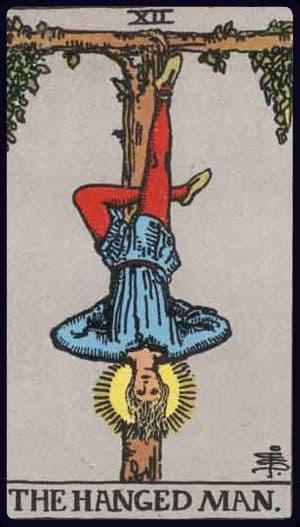
The Hanged Man is the card of suspended motion — the pause that changes what you can see.
Upright
Reversed
The Hanged Man Meaning
Upright
The Hanged Man points to a pause that is not empty, even if it feels unproductive from the outside. It often appears when surrender, letting go, or stepping out of habitual effort is what makes a new perspective possible. This card can involve sacrifice, but usually in a precise sense: releasing one way of seeing so another can emerge. In life, work, or relationships, it reflects the moment when forcing movement stops helping, and a period of stillness begins to reveal what action had kept hidden.
Reversed
Reversed, The Hanged Man often reflects the strain of a pause that has lost its purpose. Delays may be real, but resistance and stalling often deepen them, especially when indecision keeps getting mistaken for thoughtfulness. This card can also point to martyrdom: remaining suspended not because it still teaches you something, but because it has become part of how you understand yourself. What once required waiting may now require a different kind of honesty — that the perspective has already arrived, and what remains is the difficulty of acting on it.
The Hanged Man as a Daily Card
The Hanged Man sees the world differently by choosing to be still. Today, consider that suspension isn't failure — it's perspective.
Lean toward
The pause that changes the view.
Watch for
Calling delay wisdom when it's only delay.
What situation might look completely different if you stopped trying to fix it?
In Different Situations
Relationships
There are times when a relationship question stays unanswered because every attempt to resolve it repeats the same argument. The Hanged Man brings attention to what becomes visible when you stop trying to secure a particular response. Distance can offer perspective; it can also become a way of avoiding an uncomfortable conversation. This card doesn't promise reconciliation or tell you to wait indefinitely. It asks what the pause is revealing about your expectations, and whether you're making room to see differently or simply accepting a standstill that costs you too much.
Career
A career can look motionless from the outside while an important change in perspective is taking place. The Hanged Man speaks to periods when the usual measures of progress, a promotion, a title, a bigger plan, stop answering the real question of what your work is for. Taking time to reconsider the direction can be deliberate rather than passive. But a long pause can also turn into an identity: the person always preparing, never testing what they have learned. This card distinguishes useful reconsideration from postponing a move that is already becoming clear.
Decisions
Some choices stay difficult because you keep comparing the same two futures from the same position. The Hanged Man introduces a less familiar move: suspending the need to decide long enough to question the frame itself. What looks like a sacrifice from one angle may be the price of something you value more. Still, the card's reversed tension matters. Waiting can become an elaborate way of avoiding consequences. The issue is whether the pause is producing a clearer view of the trade-off or only postponing the moment when an imperfect choice has to be owned.
Burnout
When effort stops producing the relief or progress it once did, pushing harder can feel strangely easier than stopping. The Hanged Man pictures a body held still, with the view turned upside down. In a period of exhaustion, that image brings up the discomfort of not being useful for a moment. A pause may expose how much of your worth has become tied to constant output. Yet surrender is not endless self-sacrifice. If you are always the one absorbing the delay, the card also questions the habit of calling that endurance patience.
Feeling Stuck
Stillness has two very different faces in The Hanged Man. One is the pause that lets a familiar problem look different; the other is suspension that continues long after there is anything new to learn. When life feels stuck, you may not need a dramatic answer so much as an honest account of which kind of stillness this is. The card resists treating every quiet period as failure. It also resists calling every delay wisdom. Perspective is valuable when it changes how you see the ground, not when it becomes another reason never to touch it.
New Beginnings
An opening doesn't always arrive with the urge to rush through it. The Hanged Man can describe the odd interval when an old way of seeing has loosened but a new one has not settled. From outside, it may look like hesitation. From inside, there may be genuine work in learning what this beginning asks you to release. Still, waiting for a completely different perspective can become another demand for certainty. The card gives a new start room to feel unfamiliar without insisting that suspension itself is the destination.
Grief and Loss
Grief can change your sense of time. Other people's days continue, while your own may feel held in place around an absence. The Hanged Man gives that suspension an image without calling it failure or a lesson you are supposed to learn. A changed perspective sometimes comes slowly, and sometimes the pause simply feels like a pause. There is no obligation to find meaning in loss. The card's more difficult edge is the difference between allowing life to feel altered and believing you must remain motionless to honor what mattered.
Recurring appearance
What does it mean when The Hanged Man keeps appearing?
The pause may be part of the change. Delay can become its own kind of seeing.
Spreads that work well with The Hanged Man
Past, Present, Future
3 cardsThe classic three-card arc. Where you've been, where you are, and where the energy is heading.
View spread →New Chapter
5 cardsDesigned for life transitions — starting something new, ending something familiar, or standing in the space between. This spread is Liminal Tarot's signature.
View spread →The Threshold
5 cardsFor moments when you know something needs to change but you can't yet see what comes next. This spread sits with you in the doorway — not rushing you through it, not pulling you back.
View spread →Pairs with The Hanged Man
Begin your practice
Draw The Hanged Man in a reading
Context transforms a card's meaning. A full reading weaves your question, your spread, and your cards into a coherent reflection.